
Which Claude AI integrations actually help realtors?
Start with the systems that connect an interested buyer or seller to a licensed agent: an authorized MLS/IDX website, CRM, email, calendar and brokerage-approved files. Claude can assist with summaries, drafts, data checks and research within permitted integrations. The resulting inquiry and human handoff matter more than the number of apps connected.
I've worked with IDX (Internet Data Exchange) since 2008, including IDX development for a Salem, Oregon real estate company with more than 60 agents. That experience taught me that a property-search website is only one part of the system. Teams also need accurate listing display, useful search experiences, clear lead ownership, reliable routing and a response process that works when an agent is at a showing.
AI can help at specific points in that journey. But a brokerage should not buy software on the promise that connecting Claude to an MLS will automatically create listings, harvest prospects, negotiate offers or book showings. Those are different technical and professional responsibilities.
Start with the result a real estate team wants
| Desired result | Tools to consider | What to verify |
|---|---|---|
| Buyers find relevant listings and ask for a showing | IDX search + lead form + CRM + calendar | MLS permission, listing status, contact consent, showing instructions |
| Leads reach the correct agent sooner | CRM + email notifications + brokerage assignment rules | Duplicates, agent ownership, opt-outs, escalation when unavailable |
| Agents spend less time drafting marketing | Claude + approved listing brief + Canva or documents | Property facts, rights to photos, fair housing and broker review |
| Brokers understand properties and financial performance | Approved reports + CSV exports + analysis | Correct property mapping, accounting categories, assumptions |
| Long documents become faster to review | Claude + permitted document repository | Confidentiality, missing pages, citations and licensed/legal review |
These are workflow options, not claims that any particular vendor provides every listed capability or that Mandile SEO has connected a client's private accounts.
1. IDX and MLS websites: help buyers search without losing your brand
IDX is a set of policies and technology that allows eligible MLS participants to display authorized listing data on participant-controlled websites. A useful IDX website lets buyers explore properties and request help from the brokerage rather than immediately redirecting every search to a third-party portal. Read the National Association of REALTORS® IDX policy overview.
An IDX setup may include a WordPress or custom website, property-search widgets, map search, saved searches, lead registration and brokerage branding. The allowed feed fields, property photos, attribution, refresh frequency, sold data and use cases still depend on the MLS and vendor agreement. Do not assume a data feed authorizes AI training, unrestricted reuse or publication of private fields.
Current technical distinction: RETS is a legacy real estate transport standard; the RESO Web API is its modern successor. RESO sets standards but does not hand developers live listing feeds. The local MLS or an authorized vendor controls access and licensing.
Claude has no universal “connect to any MLS” switch. A project may use an approved IDX vendor API, the CRM's supported data, or a custom server with documented permissions. I would never begin with a scraper of restricted MLS pages when the required data should come from a licensed interface.
Does IDX help real estate SEO?
IDX may create useful search and detail pages, but an IDX feed is not an automatic SEO growth strategy. Duplicate listing content, excessive thin pages, inaccessible JavaScript, poor canonical handling and restrictive MLS rules can limit discoverability. The best local real estate websites also include original neighborhood context, agent expertise, meaningful buyer and seller answers, and useful contact paths.
For a brokerage with many agents, it also matters who owns and edits each agent's profile, area content and listing-related page. A centralized technical plan helps prevent duplicated agent landing pages from cannibalizing one another.
IDX software options and typical cost structure
One verified example is IDX Broker, which publicly listed Core at $60/month, Engage at $99/month and Elite at $149/month in October 2026. Those are advertised base tiers, not a total installed project price; setup, MLS-related charges, hosting, CRM add-ons and custom development may be separate. Compare supported MLS markets, data rights, site control, API access and long-term ownership before selecting a vendor.
Another established IDX provider is iHomefinder. I would check current coverage and contractual fit rather than present one vendor as universally best. And no: a new IDX package is not always necessary if the brokerage already has a functioning, properly licensed solution.
2. The top Claude integrations for real estate agents and brokers
CRM and lead routing: give every new inquiry an owner
For many teams, the most valuable integration is the one that prevents a buyer from waiting indefinitely for a reply. Claude can help interpret an approved inquiry, summarize context or prepare a suggested response. Actual CRM writes depend on connected permissions and supported tools.
Explore Claude's HubSpot connector and Anthropic's current connectors directory. For specialist real estate CRMs such as Follow Up Boss or Lofty, verify each platform's current API, approved app access and data-sharing terms. Do not infer a native Claude connector exists just because a CRM has an API.
In a 60-agent environment, ownership rules are essential. Who receives an unassigned inquiry? What happens when an agent is out? Does an existing client stay with their agent? What if the same person fills two forms? These questions need written answers before turning on automatic assignment or messaging.
Gmail, Google Calendar and Drive: reduce inbox and document chasing
With approved Google Workspace connectors, Claude can search permitted emails and files, draft responses, and check calendars. Use Anthropic's official Google Workspace guide to review the current capabilities and approval model. Drafting a seller update is different from sending it; collecting a preferred showing time is different from successfully booking it.
Marketing production: turn an accurate listing brief into reviewable content
Claude can help turn a broker-approved listing brief into a first-draft caption, social post, property video outline, open-house checklist, newsletter or neighborhood FAQ. Canva's Claude connector listing is one option to evaluate for content workflows. A broker or authorized team member should verify property characteristics, disclaimers, photography rights, current status and compliance before publishing. AI should not invent school ratings, neighborhood demographics or a property's features.
Documents: surface exceptions without pretending to practice law
Claude can summarize a disclosure packet, offer, inspection notes or agreement from files the broker is authorized to use. A helpful output is a checklist of passages to review with links back to the source, not a claim that an AI assistant has cleared a contract. Licensed professionals and legal counsel remain responsible for professional interpretation and consequential decisions. Keep confidential transaction files out of unauthorized third-party systems.
Property and commercial financial analysis
With approved exports from accounting and property systems, Claude can help clean vacancy and maintenance data, reconcile property categories, or build a reviewable scenario model. For commercial underwriting, an analyst may draft a discounted cash flow (DCF) model and test cap rates, rent growth, operating costs and discount assumptions. That model needs independent formula and source checks; it is not represented as equivalent to Argus or an appraisal.
QuickBooks reports or CSVs may help where the brokerage has appropriate access. See the QuickBooks connector listing for supported account actions. Don't feed confidential client financial details into a tool without confirming permissions, vendor processing terms and data minimization.
Broker operations: approved tasks, updates and handoffs
Approved Slack, Asana, Monday.com or Zapier workflows can help manage onboarding, open-house follow-up, marketing approvals and tasks. Review the official connector directory for availability and scopes. The right workflow should produce an auditable next action with a human fallback, not an unreviewed stream of messages.
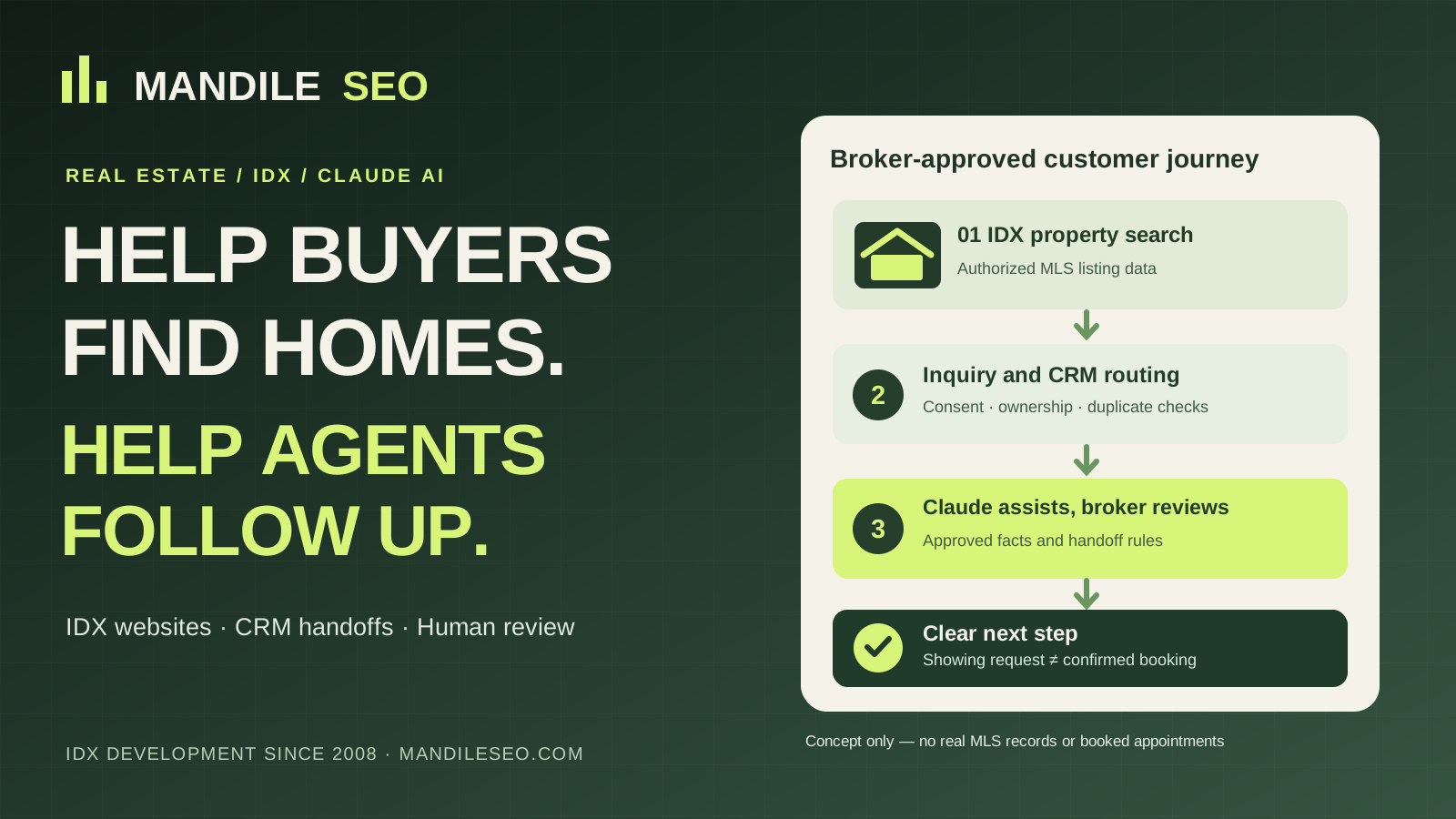
3. Example: IDX visitor to a showing request, without inventing an appointment
- Buyer searches: A person views authorized MLS listings on the agent or brokerage's IDX website. The property data follows the applicable MLS rules.
- Inquiry arrives: The visitor requests information or a showing and provides contact details with appropriate notice and consent.
- CRM lookup: An authorized integration checks for an existing record, ownership and opt-out flags before proposing a new one.
- AI assistance: Claude may summarize the request and draft a response using only approved property facts and instructions.
- Broker approval: The licensed agent or approved policy handles consequential replies, fair-housing-sensitive questions and showing instructions.
- Calendar verification: A requested time is confirmed only after a permitted scheduling action succeeds. Otherwise it remains a request awaiting agent confirmation.
- Document results: Record the actual event, rejection, duplicate or failure. Route anything ambiguous back to staff.
This is a conceptual architecture, not a demonstration of a live MLS feed, automated message or booking system.
4. What about probate records and off-market real estate leads?
Some agents explore probate, public filings and other specialized sources to understand potential property needs. Those records can contain deeply sensitive family and estate information. A public record is not blanket permission to harvest heirs' personal details, bypass court-site controls, or start automated solicitation.
A safer project begins with attorney or brokerage review of permitted data use, website terms, access authorization, privacy expectations and applicable contact laws. Workflows can focus on lawful case-level analysis, approved property research and records the firm is entitled to process. Avoid collecting or exposing unnecessary information about bereaved individuals, relatives or people who have not agreed to be contacted.
The NAR data privacy principles emphasize transparent collection, limited retention and protecting client information. Those principles should inform any AI-powered lead research.
5. Broker approval, fair housing and MLS rights are not optional
A real estate AI workflow must be designed around applicable laws, advertising rules, MLS policies, brokerage procedures and permissions. The U.S. Department of Housing and Urban Development's AI and Fair Housing guidance warns about discriminatory algorithmic housing advertising and screening. Don't use AI to steer buyers or sellers based on protected characteristics or proxies, and don't let automation make unreviewed housing decisions.
Licensed representation, financial commitments, legal interpretations, negotiation, advertising approvals and real estate contracts require the appropriate authorized people. Credentials, listing data and private client records should have least-privilege access and revocation procedures. Anthropic's connector guidance explains that access follows the underlying app permissions and connector configuration.
6. Should your brokerage buy a connector or hire an IDX/AI developer?
A single agent may just need an existing IDX package and a reliable CRM notification. A team or multi-office brokerage may need shared website architecture, specialized lead assignment, custom property-search UX, integration testing and agent access controls. Don't start with a custom MCP server if an existing supported feature already performs the required job.
When custom implementation is appropriate, I'd scope the work around an identifiable result: “Help more interested website visitors reach the correct agent and receive a verified next step.” A technical plan should specify MLS/vendor permissions, lead sources, API ownership, data retention, error handling, approvals, accessibility, mobile behavior and what success actually means.
Turn property searches into qualified conversations.
I've worked on IDX development since 2008, including a Salem real estate company with more than 60 agents. If your brokerage needs better IDX pages, licensed MLS integration, CRM routing or Claude-assisted follow-up, start with the actual bottleneck. We'll review the tools and permissions, then define a focused scope and written quote.
Independent implementation service, not legal advice. Claude and Anthropic are marks of Anthropic; IDX Broker and iHomefinder are their respective owners’ brands; REALTOR® is a collective membership mark owned by the National Association of REALTORS®. Product names are used descriptively without sponsorship, endorsement, or current MLS affiliation. Historical IDX/MLS projects do not grant new feed or AI reuse rights. No guaranteed rankings, leads, listings or booked showings.
Frequently asked questions: Claude AI for realtors
What are the best Claude AI integrations for real estate agents?
Start with the systems holding your actual inquiries and records: an authorized IDX/MLS search website, your CRM, Google Workspace or Microsoft 365, calendar, and brokerage-approved documents. The strongest first project is usually a reliable inquiry-to-agent handoff—not connecting every possible tool.
Can Claude access live MLS listings directly?
Not by default. MLS and IDX access depends on participant authorization, the local MLS agreement, data licensing, vendor interfaces and allowed use. A custom integration may use an authorized data interface or approved intermediary; a Claude connector by itself does not confer MLS rights.
Can AI book property showings automatically?
It can collect a request. A confirmed showing requires authorized scheduling access, availability, showing instructions, appropriate approval and a successful provider response. A requested time must not be represented as a confirmed appointment.
Can IDX property pages rank on Google?
Some licensed, crawlable and sufficiently useful listing pages can be discovered, but JavaScript rendering, indexability, canonical configuration, duplicate content, MLS display restrictions and source availability all affect results. Publishing thousands of listing URLs does not guarantee indexing or search rankings.
What does a Claude and IDX website integration cost?
Costs depend on the chosen IDX platform, MLS/vendor data permissions, CRM and calendar subscriptions, integration scope and maintenance. IDX Broker publicly lists base monthly tiers, but setup, MLS-related and custom implementation charges need separate verification. Mandile SEO scopes projects individually.
Do brokers with many agents need separate lead-routing rules?
Yes. A multi-agent brokerage should document lead ownership, round-robin or team routing, assigned service areas, opt-outs, duplicate contact handling, agent availability, licensed oversight and a fallback queue. Agent and brokerage access must be tested before automated writes.
More real estate AI and website resources
- Claude connectors and MCP setup for small businesses
- Real estate AI agents for buyer and seller inquiries
- AI workflows for Salem and Keizer real estate brokers
- Write a practical AI integration brief before buying
- Questions to ask before hiring an AI agent developer
- AI automation for small business inquiries
Industry and product information checked against official sources on October 28, 2026. IDX permissions, connector capabilities, vendor pricing and MLS policies can change. Confirm your own MLS agreement, current product terms and professional obligations.