
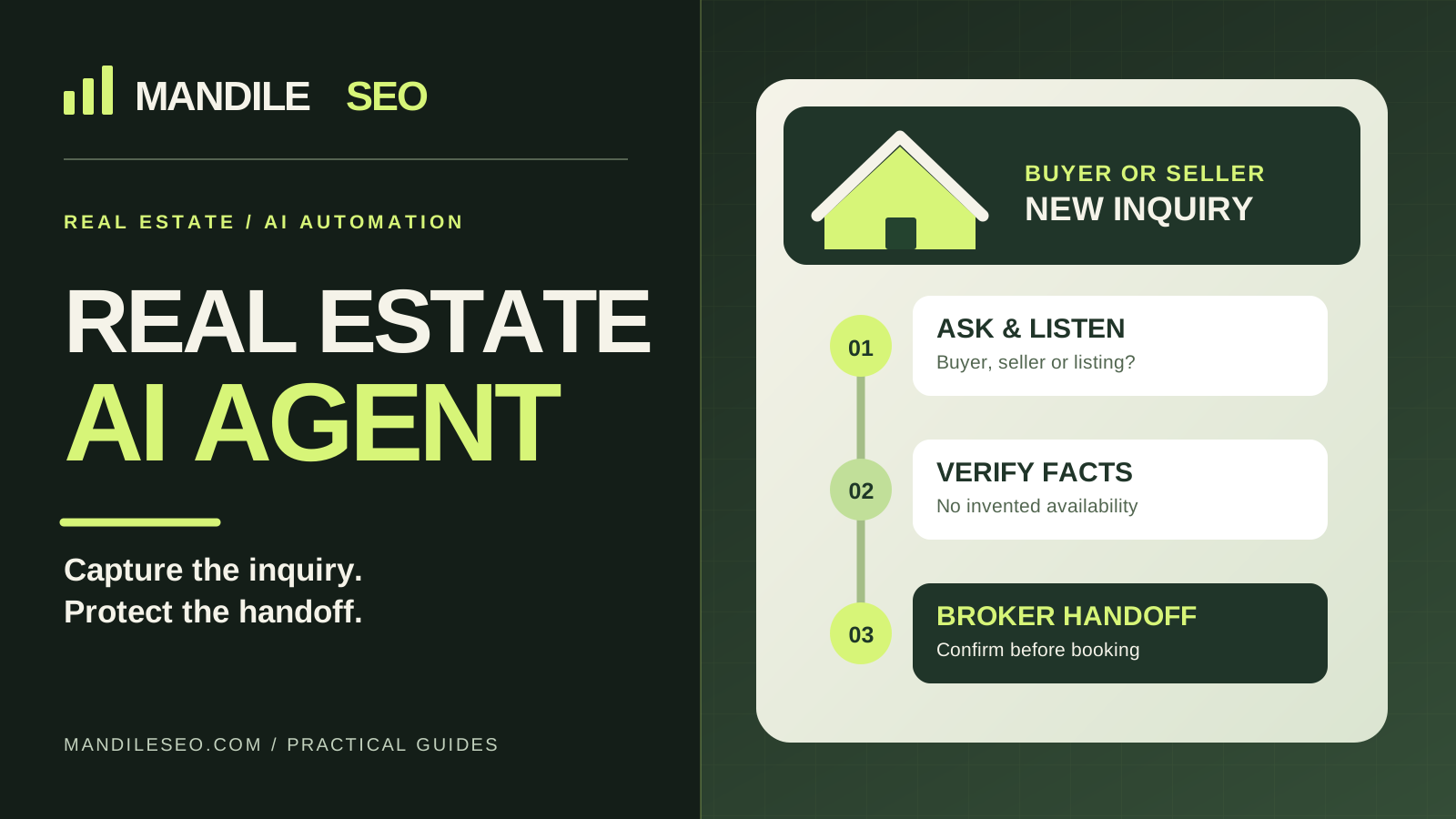
What is a real estate AI agent?
A real estate AI agent is software configured to handle a defined part of the buyer or seller inquiry process. Depending on its connected tools and approved rules, it can answer routine questions, gather contact preferences, classify a request, and initiate a handoff or calendar check. An AI agent is not a licensed broker, a substitute for reviewing disclosures, or proof that an appointment happened.
Think about a buyer standing outside a yard sign in Glendale, Arizona, or a prospective seller researching agents in Salem, Oregon. Both may want a quick response, but the questions can be complex: Is a property still active? What does the seller permit for showings? Is there an HOA restriction? Can the broker discuss a valuation this week? Those facts change. The agent’s real job is to capture the intent, use only an approved source of truth and connect the person with someone authorized to answer.
That makes an AI receptionist for realtors more useful when it has narrow responsibilities and verifiable integrations than when it sounds impressively human. Start with a single operational bottleneck—not a promise that automation will win listings on its own.
Why real estate inquiries get stuck in voicemail and inboxes
Showings, open houses, negotiations, inspections and client calls make real estate work interruption-heavy. A request can arrive through a website contact form, QR code, business phone line or a supported portal integration. If no one acknowledges it or records what the prospect needs, a team may have to reconstruct the conversation later.
There is no universal, verified number showing that every real estate caller abandons voicemail or that a particular reply time determines who a buyer hires. Instead, measure your own operation: the number of eligible inbound inquiries, time until first useful response, consented conversations, handoff completion, and appointments actually confirmed. That baseline tells you whether a new system is worth paying for.
For leads from Zillow, Realtor.com or a specific CRM, check the platform’s terms, available API or approved partner connection, and the customer’s contact permissions. A generic automation cannot assume permission to scrape a portal, send marketing texts, or reuse listing content.
What a real estate AI agent can do—and what still needs approval
| Capability | Standard CRM automation | Configured real estate AI agent |
|---|---|---|
| Inbound response | Triggers an approved template after an event. | Can converse about an inquiry using approved business facts. |
| Lead qualification | Collects structured fields and follows predetermined branches. | Can ask adaptive follow-up questions, subject to nondiscriminatory rules. |
| Property details | Displays fields synced by an authorized system. | Can explain verified listing details but must defer when the data is missing or stale. |
| CRM updates | Uses tested mappings and webhooks. | Can draft structured notes; actual record changes still need authorized, confirmed tools. |
| Scheduling | Offers a booking link or real available slots. | Can collect preferences; a showing is confirmed only after brokerage and calendar checks. |
| Failure handling | Stops or routes on a predefined exception. | Needs explicit uncertainty, human-handoff and fallback rules to avoid invented answers. |
AI agents are not automatically better than simple triggers. For a basic contact-form acknowledgment, a reliable CRM automation might be all you need. Conversational AI becomes worth exploring when your team repeatedly loses context between the first question and the next human action.
Four real estate AI agent workflows worth testing first
1. AI receptionist and missed-call text-back for real estate
A defined inbound voice assistant can identify the brokerage and disclose that it is automated. It can ask whether the caller is inquiring about a property, looking to buy, interested in selling, or requesting an existing client update. It can log a request or attempt a human transfer only where its phone provider supports the action and returns confirmation.
Missed-call text-back can help with follow-up, but an unanswered call alone does not establish permission for every automated marketing text. Check applicable consent, opt-out, quiet-hours and messaging rules first. A sample initial reply might be: “You reached the [Registered Brokerage Name] team. We missed your call. Are you inquiring about a listing or a buyer/seller consultation? Reply STOP to opt out.” Send it only when the applicable permissions and provider rules allow it.
For implementation details, read our AI phone agents guide, which covers call scope, escalation and testing.
2. Automated real estate lead qualification that avoids discriminatory screening
Instead of using an opaque “lead score” to decide who deserves service, define relevant, neutral questions: transaction type, target area, property type, timing, whether the person is seeking a showing or consultation, and the preferred way to follow up. A broker may also need to ask about existing representation and financing in an appropriate, consistent manner. Personal or financial documents should not be collected by a public chatbot without a secure, approved process.
Do not steer buyers toward or away from neighborhoods based on protected characteristics, guessed demographics or proxy attributes. Do not treat someone seeking a smaller budget or a longer timeline as automatically unworthy of a response. Create a safe human-review route for anything the assistant cannot answer or fairly categorize.
3. Showing requests and a 24/7 appointment-request assistant
A website or phone assistant can accept a showing request at any hour, including when the team is unavailable. That does not mean it can grant access to a listed property. Availability may depend on the brokerage, seller instructions, occupied-property rules, lockbox procedures and a connected calendar.
Use distinct statuses: requested, awaiting broker or seller confirmation, and confirmed. If a caller asks for Friday at 2 p.m., the draft response is “I can pass along Friday at 2 p.m. as your preferred time. The team will confirm whether that showing is available.” Only state “You are booked” after the real booking system confirms the reservation.
4. Open house QR inquiries and consent-aware follow-up
A brokerage-approved QR code can send a visitor to a mobile-friendly page with property materials, viewing information and a request form. The agent can collect questions or preferred contact details. Any subsequent SMS or email sequence must honor the purpose and permissions communicated to the visitor. The system should not imply that scanning a QR code authorizes unlimited future marketing.
Do not fabricate property inspection reports, availability, association rules, seller disclosures or MLS facts. Provide only documents the brokerage has rights to distribute, from verified sources, and route interpretations to the licensed professional.
Oregon brokerage advertising rules and fair-housing safeguards
These are foundational requirements—not optional afterthoughts—for a real estate AI agent that participates in brokerage communications or ad production.
Oregon brokerage advertising: truthful content and prominent identification
According to the Oregon Real Estate Agency’s online advertising guidance, real estate advertising must be truthful, accurate and not misleading. Listing advertisements require appropriate seller authorization. The brokerage’s registered business name needs to be displayed as required by Oregon rules; digital and social channels have specific disclosure requirements, including limited one-click accommodations in certain contexts.
The Agency’s 2026 team guidance emphasizes that the registered business name must be immediately noticeable in team advertising and that teams must not present themselves as independent brokerages. Where both licensed and unlicensed members are named, their roles must be clear. AI-generated emails, web pages, social ads and scripts need the same brokerage review as manually created materials.
Only approved listing data should be published. An AI agent must not continue describing a pending or sold property as active because its knowledge base is out of date. Assign a human owner for changes and correction requests. See the Agency’s advertising accuracy guidance.
Fair housing: avoid discriminatory steering and automated exclusion
The Fair Housing Act protects people in housing-related transactions based on race, color, national origin, religion, sex, familial status and disability. AI-generated ads, lead-routing rules and automated conversations must not exclude, discourage or steer people based on those characteristics, or on proxies used to approximate them.
HUD’s guidance on digital housing advertising highlights discriminatory risks in automated targeting and delivery. A safer workflow focuses on property characteristics and the prospect’s stated transaction requirements, offers a consistent path to a licensed broker, logs exceptions for review, and tests outputs for disparate treatment. Neutral scripts alone are not proof that an entire advertising system is compliant.
Additional operating controls: identify the assistant as automated; avoid giving legal, mortgage or contract advice; secure client data and recording consent where applicable; validate all tool outputs; provide clear escalation and a pause switch; and never claim an email, transfer or CRM action succeeded without an actual system confirmation. Your brokerage and legal advisers should approve implementation-specific rules.
Example: from a listing inquiry to an approved broker handoff
This sample is an illustrative conversation, not a live recorded call or proof of a completed booking.
- Greeting: “Thanks for contacting [Registered Brokerage Name]. I’m the virtual assistant. Are you asking about a specific listing, or would you like to speak with a broker about buying or selling?”
- Intent: The caller identifies a listing address or requests a seller consultation in the Salem or Phoenix area.
- Approved details: The assistant asks for the requested service, preferred timing and contact method, using only verified listing information.
- Uncertain fact: If asked whether an HOA allows short-term rentals, it says, “I don’t have verified HOA rules for that property. A licensed broker can help you find the correct documents.”
- Consent and handoff: The assistant asks permission to share the inquiry with the team. It records a lead only if the authorized CRM reports a successful write, or transparently offers an alternate contact route if the integration is unavailable.
- Scheduling status: A requested showing remains unconfirmed until the calendar and brokerage process acknowledge it.
Pair an AI receptionist with local SEO—not promises of guaranteed rankings
A call-answering workflow does not bring visitors to a website by itself. Clear local service information, eligible and accurate Google Business Profile details, useful buyer and seller resources, accessible mobile pages and trustworthy third-party references may help prospective customers discover and evaluate your brokerage. Once an interested person contacts the business, an approved intake system can improve the handoff.
For local examples, see AI workflows for Salem and Keizer brokers or explore AI SEO versus traditional SEO. Mandile SEO also offers fast, conversion-focused website builds, but neither SEO nor automation can guarantee a particular ranking, representation agreement or closing.
A measurable 30-day real estate AI agent pilot
Before deploying, review a baseline from your own business and agree on a limited workflow. Once the connected agent has passed test calls and the owner has approved launch, measure:
- First useful response: median and 90th-percentile times for eligible inbound requests, broken out by channel and staffing hours.
- Lead routing: proportion of inquiries accurately summarized and delivered to the intended person or CRM.
- Confirmed bookings: appointments actually verified by the scheduling system—not requests or draft slots.
- Quality and consent: escalation errors, misstatements, duplicate records, customer opt-outs and any compliance incidents.
- Effort and cost: staff time measured before and after, plus setup, platform, per-minute, messaging and support expenses.
These are outcomes you can test. They are not a guarantee of a fixed weekly time saving, automatic replies within a specified number of seconds, more listings, or a specific return on ad spend. If a simple CRM rule performs better at lower cost, use that instead.
Real estate AI agent: frequently asked questions
What does a real estate AI agent actually do?
A configured real estate AI agent may answer approved buyer or seller questions, collect inquiry details, propose a follow-up, and coordinate handoff to a broker. Live calls, messages, CRM writes and booking confirmations require approved integrations and testing.
Can an AI receptionist for realtors book showings 24/7?
It can accept requests around the clock. To confirm a showing, it needs real calendar availability, access or seller instructions, brokerage approval and confirmation from the authorized scheduling system. Without those, it should collect a preferred time and clearly say the showing is not yet booked.
Can a real estate AI agent integrate with Follow Up Boss, Lofty or another CRM?
Potentially. Whether a specific CRM supports the proposed workflow depends on current APIs, permissions, licenses and plan features. Verify the integration and test record creation, duplicate handling and failures before launch.
Is using AI for real estate lead screening legal?
AI-assisted intake must follow applicable fair-housing, advertising, privacy and consumer-contact laws. It should focus on neutral property and transaction needs, avoid protected-class or proxy targeting, and send consequential decisions to licensed humans.
How should a broker measure an AI lead-intake pilot?
Track eligible inbound inquiries, response-time distribution, consented follow-ups, correctly routed leads, confirmed appointments, errors and customer opt-outs against a documented baseline. There is no guaranteed number of listings or hours saved.
Start with one missed call or one buyer inquiry.
Mandile SEO designs AI reception, lead-intake and follow-up workflows around your team’s approved tools. Explore a free draft before discussing integration, brokerage review and a scoped 30-day pilot. Third-party software and usage costs are separate.