
Can AI agents help Salem real estate brokers follow up with leads?
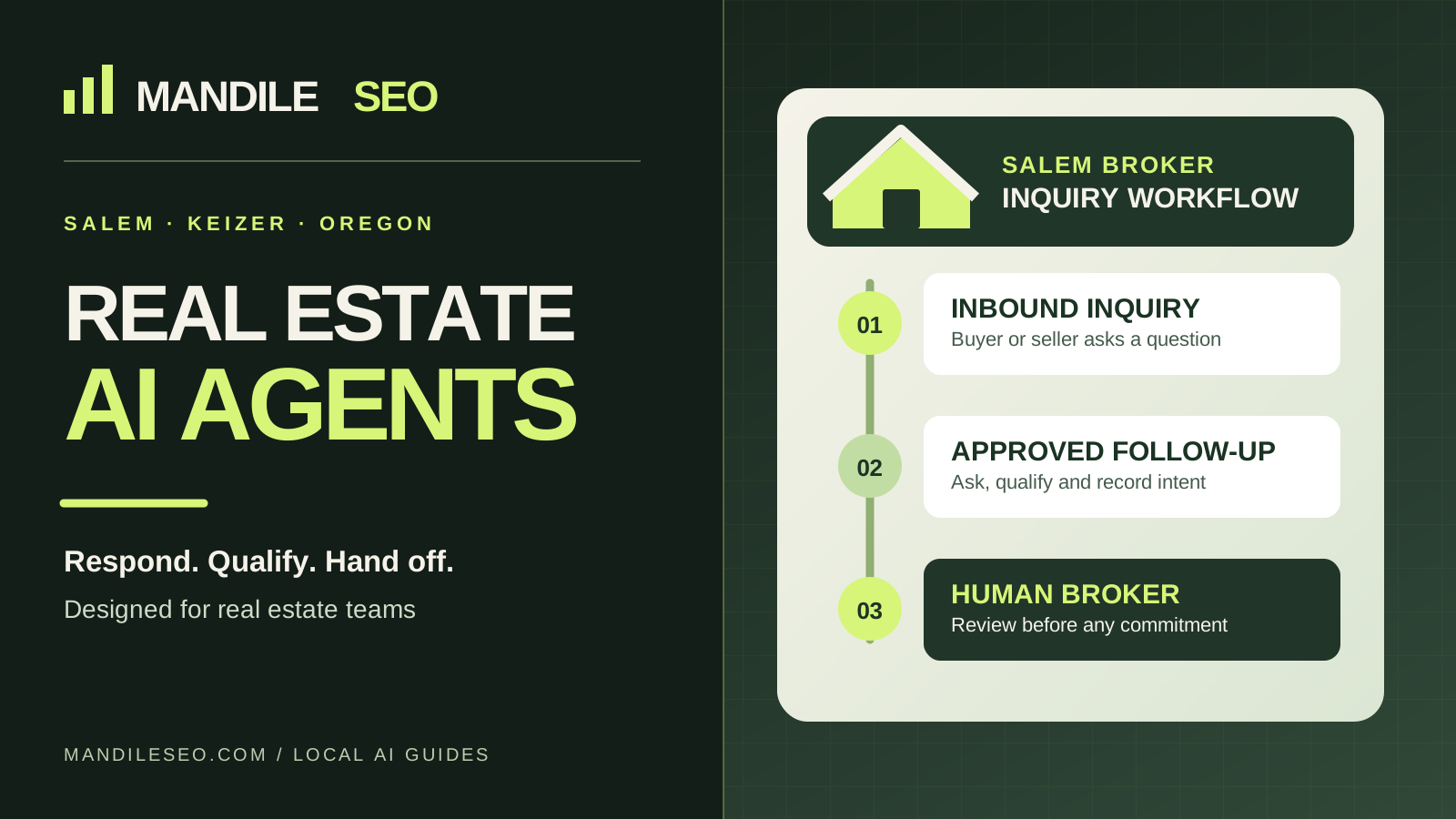
Yes—when appropriately configured. A real estate AI agent can help acknowledge an inbound inquiry, ask approved questions, route the request to a licensed broker, and prepare scheduling or CRM updates. It should never invent property availability, prices, loan qualifications, market data or a completed appointment. Start with one workflow and measure the actual results.
For independent brokers and small teams in Salem, Keizer and the Mid-Willamette Valley, the problem is often not a shortage of tools. It is the gap between a buyer or seller asking a question and a human being free to respond. Open houses, negotiations, showings and inspections compete for attention. An after-hours inquiry from a website visitor still deserves a clear next step, but that does not mean a broker needs another dashboard to monitor.
Real estate remains a relationship business. These workflows should make the relationship easier to start—not automate away disclosures, professional judgment, fair-housing obligations or client trust. The point is to reduce avoidable back-and-forth, not claim that software closes listings on its own.
For the broader national overview of phone intake, appointment requests and brokerage compliance, read our real estate AI agent guide. This Salem guide focuses on workflows and buyer/seller needs for local Oregon teams.
Five useful AI workflows for Salem and Keizer real estate teams
1. Buyer and seller inquiry intake, even outside office hours
A disclosed AI assistant on your own website can ask whether someone wants to buy, sell or schedule a consultation, then collect the preferred area and timing. For a potential seller, a helpful first question might be, “Are you considering a listing consultation or looking for general pricing information?” For a buyer, the agent can capture requested property features without assuming mortgage approval or steering toward or away from neighborhoods.
Leads originating from portals such as Zillow or Realtor.com should enter this workflow only through an approved, authorized integration. Do not assume that a platform allows scraping, unrestricted messaging or AI access to inquiry data. The prospect’s permissions and the brokerage’s rules still apply.
2. Listing-consultation requests with an accurate calendar handoff
A seller looking for a listing appointment near West Salem or Keizer might describe the property, preferred meeting method and time window. The AI can collect the request or, where a calendar has been connected and tested, offer genuinely available slots. It must distinguish “request received” from “appointment confirmed.” A human broker should approve any valuation, pricing opinion or representation commitment.
3. Consent-aware follow-up without another manual spreadsheet
Standard CRM workflows can send fast, reliable follow-ups on an approved trigger. An AI layer can help categorize an inquiry, draft a context-aware answer or summarize the conversation for a broker. Outbound email and text sequences require appropriate permissions, suppression and unsubscribe handling. The system should stop when a person opts out, and escalation to a human must work when a question becomes complex.
4. Neighborhood content grounded in real local information
There are useful story angles across Salem: historic residential architecture near Bush’s Pasture Park, established areas of South Salem, housing questions in Keizer and property types in West Salem. AI can draft a newsletter outline or turn a broker’s verified notes into a readable neighborhood guide. It should not invent market statistics, describe residents using protected-class proxies, or manufacture “current” inventory and sale prices.
Use the team’s approved MLS data and permitted sources for any listing facts, local market statistics or images. A neighborhood article is more useful when it accurately explains housing stock, access to amenities, property considerations and limitations than when it repeats a generic promise about “the hottest area.”
5. Faster first drafts for listing descriptions and meeting notes
With the owner’s permission and verified property details, AI can help draft descriptions of layout, condition and documented features for broker review. It can also summarize approved call notes into tasks such as “follow up about showing preferences” or “confirm the listing consultation time.” Before using recordings, transcripts, client documents or messages with AI vendors, check consent, vendor privacy terms, brokerage requirements and data-retention policies.
AI agents versus conventional CRM automation: what is different?
| Task | Standard CRM automation | AI-assisted workflow |
|---|---|---|
| First response | Sends approved messages when a configured trigger fires; can be near-immediate. | Can draft or deliver a contextual reply where authorized, tested and connected. |
| Qualification | Captures fields from forms and rule-based sequences. | Can ask follow-up questions and summarize the stated intent; may need review. |
| Appointment requests | Offers booking links or uses connected calendar rules. | Can converse about preferences, but must check real availability before confirming. |
| CRM records | Logs configured fields reliably through a supported integration. | Can extract proposed fields from messages, subject to validation and privacy controls. |
| Failure mode | Rigid triggers can miss unexpected cases. | Generated answers can be inaccurate or overconfident; guardrails and human review matter. |
Neither option is universally better. If a form and two automated reminders do the job, a conventional CRM rule may be simpler and cheaper. Add AI only where flexible conversation or summarization solves a real problem. AI agents do not automatically “learn” from every interaction; behavior changes require deliberate review, updates and testing.
Example: an inbound Salem seller lead
Here is one realistic, limited workflow for a brokerage-approved website inquiry. It is an illustrative script, not a claim that a booking or transfer has occurred.
- Disclose the assistant: “Thanks for contacting the brokerage. I’m a virtual assistant. Are you interested in buying, selling or something else?”
- Capture only relevant facts: If selling, ask which city the property is in, the approximate timeline and whether they would prefer an introductory call.
- Stay within approved information: If asked for a listing price, say: “A licensed broker can discuss a comparative market analysis after reviewing the property.” Do not invent a value.
- Request explicit consent for next steps: Ask whether the prospect wants their inquiry shared with the brokerage team, and confirm the preferred reply channel.
- Verify the handoff: Only after the authorized CRM actually confirms a successful record should the system mark it as received. A proposed calendar slot is not a confirmed booking.
A useful pilot measures inquiry acknowledgment time, handoff accuracy, qualified conversations and confirmed appointments—not how human the chatbot sounds. Exact response-time targets must be based on the connected systems and realistic staffing coverage.
Important safeguards: Oregon real estate advertising and fair housing
Oregon’s Real Estate Agency requires truthful advertising and conspicuous use of the registered business name, with additional team requirements. An automated assistant that drafts property ads, social posts or other solicitation material must fit the brokerage’s review and disclosure process. See the Oregon Real Estate Agency’s online advertising guidance and its 2026 team-advertising update.
Fair-housing rules matter both in advertising and the way a lead assistant responds. Do not use AI to steer inquiries, screen prospects or target housing offers based on protected characteristics or their proxies. Housing-related ad delivery and algorithmic targeting can raise fair-housing issues; see HUD fair-housing resources. Prompts should focus on the property and the customer’s stated transaction needs, not assumptions about who belongs in a neighborhood.
Broker review is also necessary for photos, seller details, prices, incentives, open-house times, claims about schools, financial qualifications and listing changes. Check MLS permissions and the brokerage’s policies before sending source data to any AI provider. “It was generated by AI” does not excuse an inaccurate advertisement.
Three low-friction AI wins to try first
- Improve a repetitive reply. Draft a polite first response for a buyer or seller website form, including the brokerage’s real name and the next human step. Have a licensed broker approve it before use.
- Build a sample intake blueprint. Choose Lead Qualification in the free Mandile SEO AI Agent Studio, enter approved business information, explore the simulated call scenarios and download the plan for review. This is a draft tool; nothing is sent or booked.
- Measure a single process. Track how quickly current inquiries are acknowledged, how many reach a broker and where information is lost. Start with that bottleneck before adding voice AI, an elaborate RAG system or a new CRM subscription.
How Mandile SEO can help Salem real estate businesses
Mandile SEO consults on local search and designs custom AI workflows around a business’s existing operating systems: inbound calls, contact forms, lead qualification, appointment requests, follow-up and CRM handoffs. For Salem, Keizer and Portland-area brokers, a project begins with a specific business problem and an approved scope—not a claim that one tool can run an entire brokerage.
The available implementation options may include website intake, calendar connections, CRM mapping, and a scoped AI phone agent through a suitable voice-platform vendor. ElevenLabs/ElevenAgents can be evaluated where the use case, pricing, permissions and integrations fit; we do not present it as already connected to a client’s phone system. Vendor fees, messaging costs, hosting and optional support are quoted separately.
For a 30-day AI pilot, we first agree on one workflow, permissions, human overrides and test cases. Your evaluation window begins only after the approved system is live. The pilot should demonstrate a measurable operational improvement, not guarantee a number of additional listings or hours saved.
Keep the human relationship. Improve the handoff.
Want a custom AI workflow for your real estate team? Start with the free builder or describe the calls and inquiries you already receive. We can review a practical pilot scope together.