
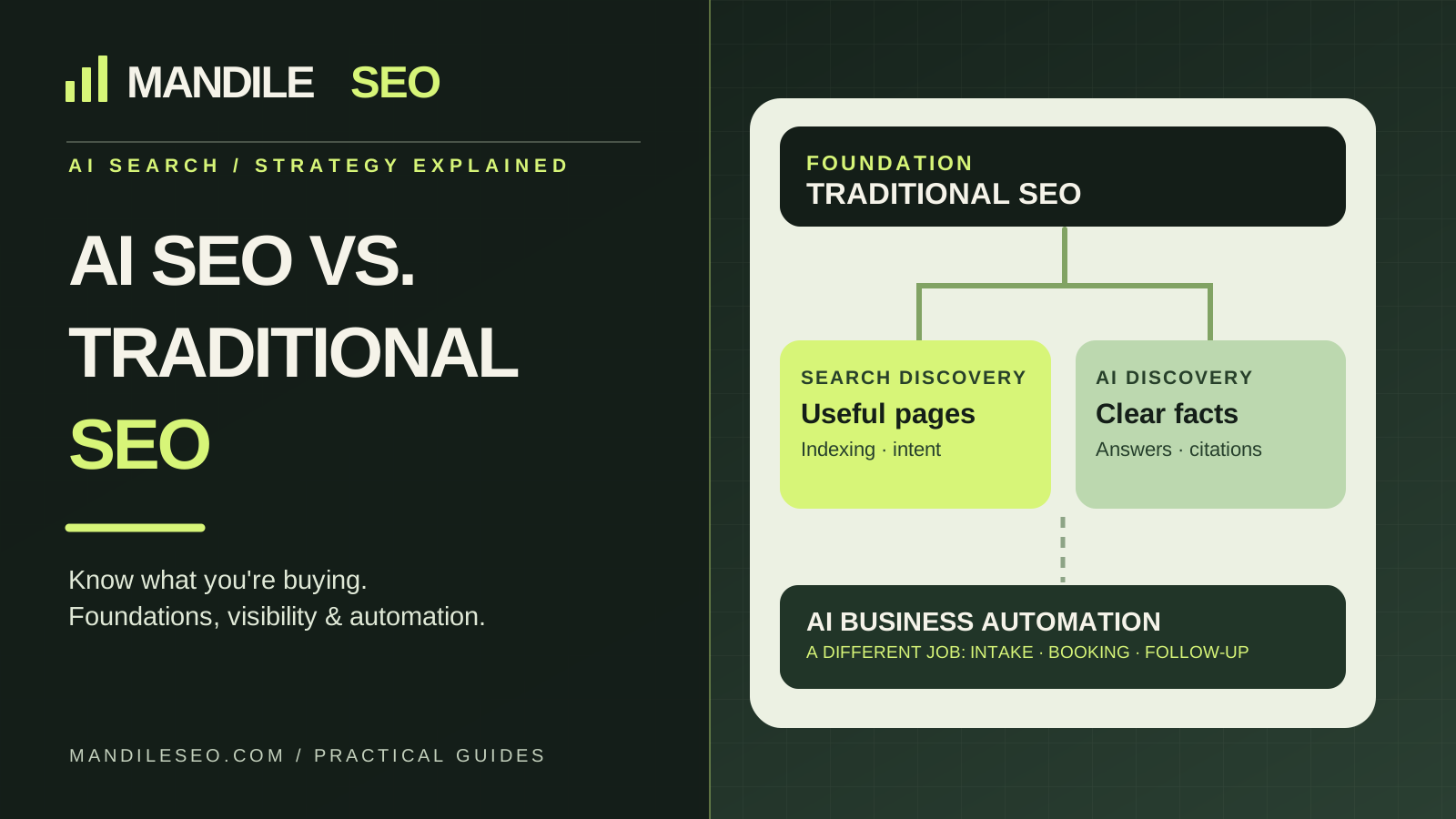
Does AI SEO replace traditional SEO?
No. Traditional SEO addresses crawlability, useful content, website structure, relevance and search experience. AI search optimization builds on those foundations to make business facts and answers easier to understand and reference. AI tools can also help execute SEO work—but automation alone does not guarantee visibility in Google, ChatGPT, Gemini or Perplexity.
First, untangle the three meanings of “AI SEO”
1. Traditional SEO: help people find your website in search results
This includes technical foundations, search intent, service pages, internal links, useful answers, Google Business Profile accuracy where applicable, and measurement through tools such as Search Console. A well-built local service page explains what the business does, who it serves and how to make an inquiry.
2. AI search optimization: make your business easier to understand in AI answers
People may ask ChatGPT, Perplexity or Gemini for recommendations or guidance rather than searching only a short keyword. Work here may include checking public information about your business, making service details explicit, ensuring pages can be crawled, and publishing clear answers grounded in real operations and verifiable experience.
Each AI product has its own discovery, retrieval and citation behavior. No agency controls which businesses an answer recommends. Do not assume the same tactics, citations or rankings apply across platforms.
3. AI-assisted SEO: use AI tools inside the work process
Drafting a content outline, grouping user questions, or triaging technical reports with AI may improve workflow efficiency. These tasks still require someone to verify facts, evaluate search intent, review technical changes and approve what gets published. Automated output is not the same as an improved search result.
There is also a fourth, separate service often mixed into these sales conversations: business automation, such as an AI receptionist or follow-up workflow. That's about what happens when a customer calls or fills in a form. It is not itself a search ranking technique.
Side-by-side: which type of work are you buying?
| Service | Typical deliverables | What to measure |
|---|---|---|
| Traditional SEO | Technical fixes, relevant pages, internal links, profile accuracy, structured content | Indexing, search queries, clicks, qualified inquiries |
| AI search optimization | Public entity-data review, answer clarity, crawlable content and citation footprint checks | Documented visibility snapshots, relevant referrals and inquiries where observable |
| AI-assisted SEO workflow | Research, drafts, quality-control checks or report preparation with human review | Time saved, factual accuracy, completion of approved changes |
| AI business automation | Defined phone, intake, booking or CRM workflow with handoffs | Calls handled, successful transfers, lead-response time, booking accuracy |
A proposal can include more than one category, but it should identify the outputs and the limits of each. “AI-powered SEO” alone doesn't tell a business owner what work will be done.
What still matters for Google Search and AI Overviews?
Google's guidance states that the normal SEO best practices remain relevant to its AI features. There is no special schema type, required AI file, or hidden optimization necessary to qualify for AI Overviews or AI Mode. A page still needs to meet applicable Search requirements. Read Google's AI-feature guidance.
That makes the practical starting point straightforward: ensure important pages can be found and indexed, publish useful service information, keep business details accurate and create original answers based on the work the business actually performs.
Google also recommends people-first content built around real expertise. AI-generated text that merely repeats what every competing website says may be quick to publish but offers a weak reason for anyone to trust it.
What this looks like for a real local-business problem
Example: a Peoria computer repair business
Suppose customers ask whether a shop handles laptop charging ports, malware diagnosis, data recovery or gaming PC troubleshooting. A generic page saying “we fix all computers” may leave those questions unresolved.
A stronger website explains the individual repair services it genuinely offers, relevant policies, service process, real address and contact methods. The business can then examine whether public third-party information accurately describes its work. These are illustrative recommendations, not claims that a specific client's search positions changed.
Example: an Oregon contractor
Consider a plumbing business that receives calls while its owner is on job sites. Better local SEO could make service and coverage information clearer for search visitors. A separate AI or phone workflow might collect missed-call details, identify urgent situations and route requests for human follow-up. One system helps people discover the business; the other manages the next step.
For questions specifically about Google Maps visibility and Business Profile basics, see our Glendale local SEO diagnostic guide.
What should an AI search optimization project deliver?
A useful engagement might deliver a before-and-after record of public search experiences, a list of service and entity-data inconsistencies, a prioritized site-content plan, implementation of approved page or schema improvements, and a written measurement method.
For multi-location organizations, it may also include a review of which location facts belong to each eligible branch, how pages relate to the parent brand and where the customer should contact that location. It should never fabricate extra locations to chase city keywords.
Ask the provider to say which claims depend on external platforms. Visibility observations from ChatGPT, Gemini and Perplexity are snapshots that can change across prompts, geography and sessions—not a stable “rank” equivalent to a Search Console metric.
What can you measure, and what remains uncertain?
For traditional SEO, Search Console provides impressions, queries, pages and clicks within its reporting limits. For AI discovery, document the exact prompt, location context, product, date, visible citations and any available referral evidence; repeat the test consistently. A result appearing once should not be sold as a sustained recommendation.
Keep separate columns for visibility and business outcomes. If a prospective customer arrives through an AI answer but doesn't contact you, that deserves attention too. The inquiry path and response time are business problems, not merely keyword problems.
Six questions to ask before buying “AI SEO”
- Which meaning of AI SEO are you selling: AI tools, AI search visibility, or automation?
- Which existing Google search problems have you verified?
- What exact pages, data, schema or workflows will you change?
- How will you validate business facts and distinguish an illustration from a result?
- How will you measure changes when AI recommendations are not consistent?
- Which accounts, materials and systems will we control after the project?
Frequently asked questions
Do I need separate SEO strategies for Google and ChatGPT?
You need a sound underlying website and accurate public business information first. Specific research and content priorities may differ by product, but you shouldn't have to create contradictory versions of your business facts for each assistant.
Does adding more schema guarantee an AI citation?
No. Structured data can help communicate supported facts, but it must match the visible page and comply with search engine guidelines. It isn't a guarantee of being cited or recommended.
Can an AI agent run all my SEO automatically?
Automation can assist repeatable tasks, but publishing, access, local-business eligibility, legal claims and meaningful performance interpretation require oversight. Ask what approval rules and tests are built into any automated process.
Not sure whether you need SEO, AI search support or lead-response automation?
Tell me what your customers currently struggle to find or what happens when they contact your business. Mandile SEO works with small businesses in Oregon and Arizona, with services scoped to the specific outcome and tools you need.