
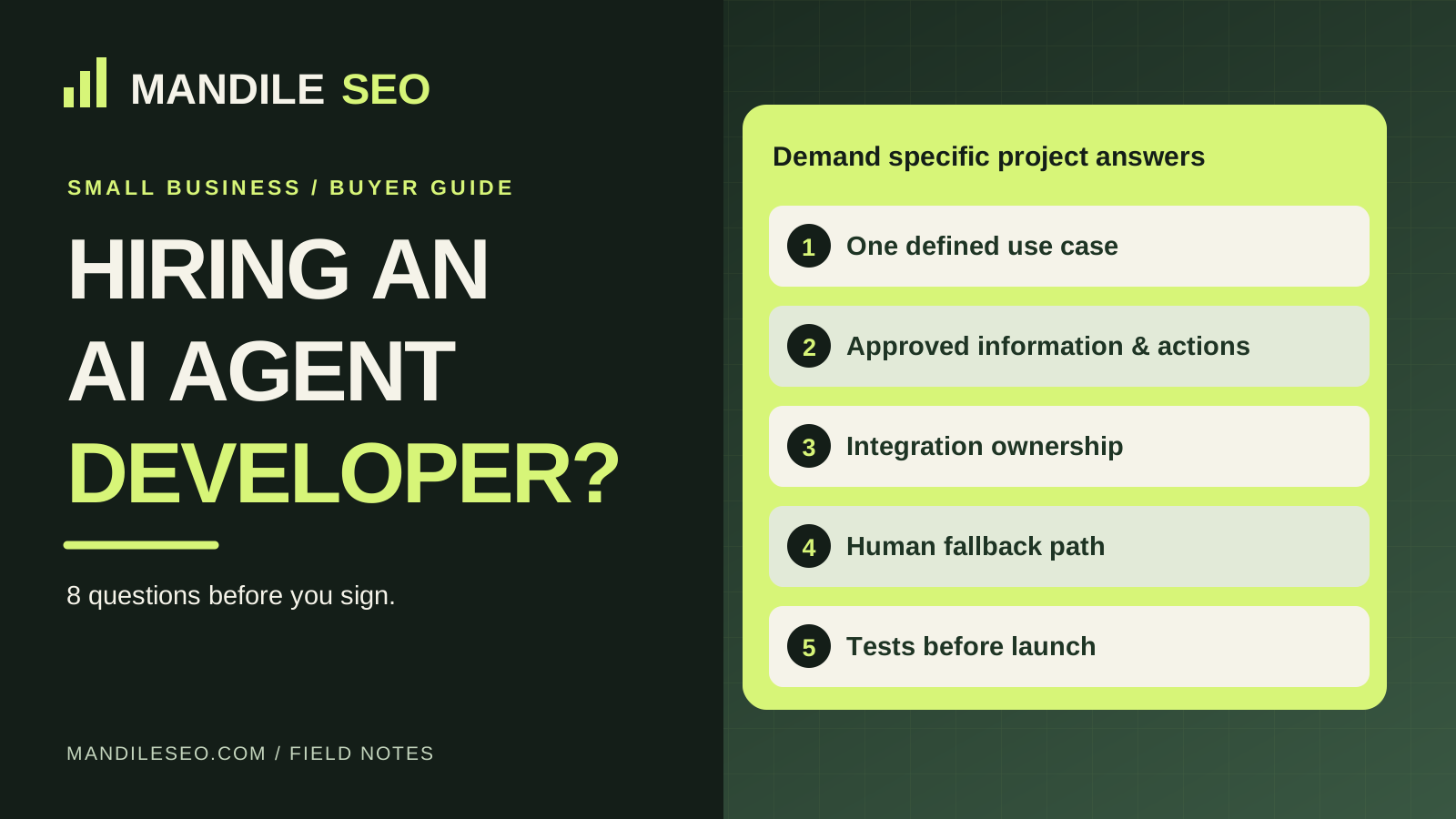
What should I ask before hiring an AI agent developer?
Ask what specific job will be delivered, which systems and credentials are needed, what the agent must never do, how people take over, how data is protected, what acceptance tests must pass, who owns the result and exactly which usage fees continue after launch.
1. What exact job will the agent perform?
Do not accept “an AI agent that handles everything” as a specification. Name the trigger, input, output and success event. An after-hours intake request, a verified appointment and a CRM task are different deliverables.
2. Are we configuring software or building a custom system?
Ask which components are vendor-hosted, which are custom and what subscriptions are necessary. A low subscription rate is not the cost of implementation. You should know what continues working if you stop paying the developer.
3. Which integrations are confirmed to work?
List the exact phone, calendar, CRM and messaging provider; verify permissions and APIs before signing. “Works with any CRM” is not a test result. For a preview-only project, the brief should explicitly state that no integration is live.
4. What can the agent say or do—and what is prohibited?
Approve a source of truth and specific prohibited actions. Sensitive, medical, legal or hazardous situations need qualified human handling. A receptionist should not guess availability or invent a service quote.
5. How will human escalation and outages work?
Request demos of unavailable staff, interrupted connections, unknown customer questions and frustrated callers. A safe fallback should still record a legitimate request without pretending a transfer or booking succeeded.
6. Who owns the data, prompts and accounts?
Confirm domain, phone number, caller information, recordings, transcripts, configuration, access logs, retention and termination rights in writing. Recording and promotional messaging requirements depend on jurisdiction, consent and platform policy.
7. Which acceptance tests must pass before launch?
- Routine request produces accurate approved answers and authorized records.
- Out-of-scope inquiry triggers human handling.
- Calendar outage never creates a false confirmation.
- Emergency language triggers approved escalation guidance.
- A caller can request a human and reach a real fallback.
- No unauthorized fee, discount, diagnosis or policy promise is fabricated.
8. What does setup, usage and support actually cost?
Demand separate line items for design, configuration, API/model tokens, telephone minutes, SMS, CRM connectors and continuing maintenance. Ask what happens when vendor rates, APIs or business policies change. See our AI agent pricing guide for independently published vendor examples, not universal build-cost averages.
A simple developer comparison worksheet
| Compare | Provider A | Provider B |
|---|---|---|
| One defined use case | Write down scope | Write down scope |
| Integrations verified | Evidence + limits | Evidence + limits |
| Human escalation | Test and fallback | Test and fallback |
| All recurring charges | Quoted breakdown | Quoted breakdown |
| Access and handover | Written ownership | Written ownership |
| Live launch criteria | Signed acceptance | Signed acceptance |
What should be in the statement of work?
Include a scope and exclusions list, dependencies, mock/test data plan, review meetings, acceptance scenarios, deployment permissions, incident response, documentation and ongoing costs. A preview/export deliverable is valid—but it must be labeled non-live.
Need a developer-ready AI agent brief?
Mandile SEO starts with a narrow workflow and a documented scope. Send your business problem and existing systems to discuss a custom quote. Third-party fees are separate.