
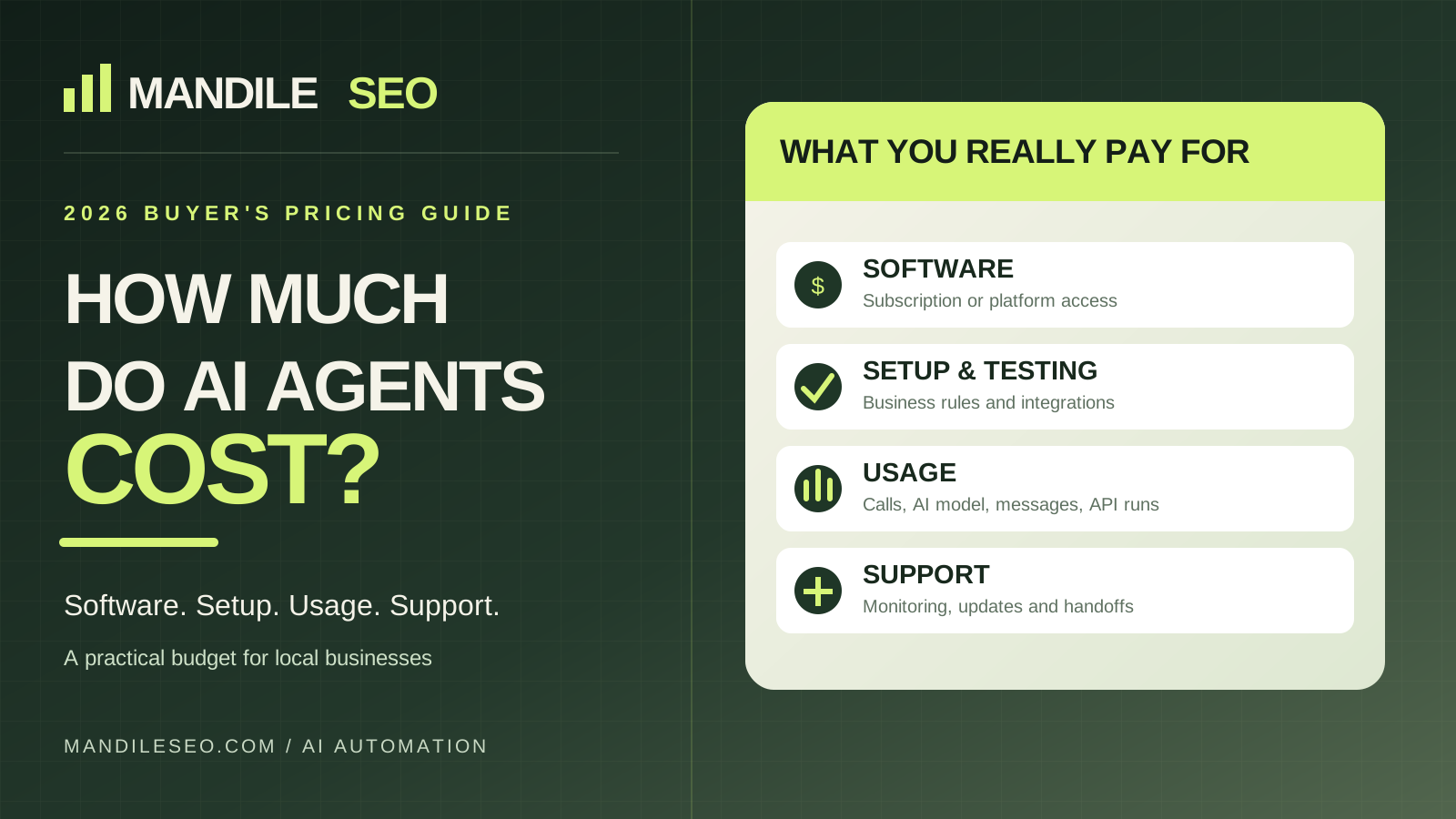
How much does an AI agent cost?
Published prices vary by product and billing unit. As of October 26, 2026, n8n advertises a hosted Starter plan from €20/month when billed annually; Retell lists voice-agent usage at $0.07–$0.31 per minute; Intercom lists many Fin outcomes at $0.99 each; and Salesforce advertises an Agentforce conversation model at $2 per conversation. These are different products and billing units, not comparable end-to-end deployment quotes. Setup, phone charges, model usage, integrations and support can add costs.
An owner asking “What will an AI agent cost my small business?” is usually trying to answer three questions: Which task should I automate? What will it take to connect the software to my actual tools? And what will I pay each month after it starts working? Start there—not with the largest advertised enterprise price.
For a local contractor, computer repair shop or service business in Glendale, Phoenix, Peoria, Portland or Salem, the best first step may be a narrow lead-intake or missed-call workflow. A complex autonomous platform is not automatically better than a simple, tested system.
AI agent pricing: four ways vendors charge
| Pricing model | What you pay for | What to check |
|---|---|---|
| Subscription or per seat | Access to a hosted tool, features, users or a monthly execution allowance | Limits, annual commitments and usage overages |
| Per minute, message or token | Voice conversations, texts or AI model processing | Which parts of the stack the quoted rate includes |
| Per outcome or conversation | A defined support resolution, successful handoff or interaction | The precise billable definition and minimums |
| Custom project and ongoing support | Scope design, integration, security review, QA, training and maintenance | Deliverables, change requests and third-party software billed separately |
Published AI agent prices: five vendor examples
These are publicly posted vendor examples checked on October 26, 2026, not Mandile SEO's rates or a promise that every listed feature is included. Pricing, limits, currencies and terms may change; confirm the current checkout or written quote before purchasing.
| Provider / use case | Advertised example | Important qualification |
|---|---|---|
| n8n: workflow automation | Starter €20/month, billed annually | Hosted workflow plan with execution allowances; outside model, phone and other integrations can carry costs |
| Vapi: voice-agent platform | $0.05/minute platform hosting, starting usage-only | Model providers are passed through at cost; platform hosting is not the full voice-system bill |
| Retell: voice agents | $0.07–$0.31/minute published voice-agent range | Selected voices, AI models, telephony and optional features affect actual spend |
| Intercom Fin: customer support | $0.99 per qualifying outcome for many outcome types | Other outcome categories and minimum commitments may differ; read the contract |
| Salesforce Agentforce: enterprise CRM | $2 per conversation under one public pricing model | Alternative credit and user models exist; licensing and implementation scope vary |
Do not compare these figures as if they were five quotes for the same agent. A $0.05 voice-platform rate doesn't buy the entire telephony and language-model stack, and a per-outcome support agent does a different job from a custom contractor receptionist.
The full cost of ownership: software + build + usage + support
Whether you configure an existing platform or hire help, budget for all four categories. Leaving out one category is how an inexpensive-looking demo becomes an unpredictable operating expense.
1. Software and infrastructure
Subscriptions may cover a workflow builder, an AI-agent platform or a helpdesk. Some tools allow self-hosting while others include hosting in a paid tier. Verify the plan's actual execution limits, number of seats, environments and support level.
2. Setup, integration and testing
A useful custom setup may involve reviewing the business's approved answers, mapping lead-routing rules, connecting a calendar or CRM through supported APIs, securing credentials, defining a human escalation path and testing what happens when the integration fails. An agency's quoted setup price should identify each deliverable and acceptance test.
3. Usage and transactional charges
Text AI may be charged for input and output tokens. Voice systems may use per-minute rates for phone carriage, recognition, synthesis, orchestration and the underlying language model. Messaging providers may charge per SMS. OpenAI publishes model-specific API rates; usage on another vendor's bundled agent may be metered differently.
4. Maintenance and human oversight
Real operations change. Business hours, prices, staff schedules, product availability and CRM APIs can change. Set aside a budget or clear ownership plan for testing updates, monitoring errors, reviewing privacy controls and transferring callers or cases to a person when the workflow can't safely finish.
Voice agent cost example: 200 calls per month
Suppose a repair shop receives 200 eligible calls per month, and each automated conversation averages three minutes. That's 600 minutes of agent usage. Applying Retell's published $0.07–$0.31/minute range gives an illustrative $42–$186 in monthly voice-minute charges at that rate. The final amount depends on the actual stack, selected configuration and any additional provider, phone-number or support fees.
200 calls × 3 minutes = 600 minutes
600 minutes × $0.07–$0.31 = $42–$186 of usage under the cited range, before any unbundled services, taxes, implementation or support.
Now ask the operational questions the rate card can't answer. What proportion of those calls need a human? Does the agent create a confirmed calendar booking or only submit an appointment request? What happens during an outage? Those choices determine both additional cost and customer experience.
For a voice-agent architecture and test checklist rather than pricing, read the separate AI phone agents for small business guide.
What should a small business budget for a custom AI agent?
There is no credible single industry-standard setup fee that covers every AI agent. The broad “$30 per month to $300,000+” headline mixes low-cost subscriptions with highly complex engineering engagements. Likewise, generic $1,500–$5,000 or $50,000–$300,000 ranges should not be mistaken for verified 2026 market averages or Mandile SEO price commitments.
For your own budgeting, distinguish these practical project types:
| Project scope | What's actually involved | What drives the quote |
|---|---|---|
| Off-the-shelf software | Configure a supplied template or basic knowledge-based assistant | Plan fee, business-owner setup time and usage caps |
| Single-workflow custom pilot | One defined use case, e.g. lead intake and a reliable follow-up handoff | Current systems, API access, testing and exception handling |
| Multi-system integrated agent | Calendar/CRM sync, role-based access, approvals and recurring operations | Number of connected tools, business rules, data handling and monitoring |
| Enterprise or regulated system | Complex security, large-scale access controls, audits and tailored infrastructure | Compliance review, reliability targets, system integration and governance |
For an accurate quote, have the provider write down the outcome, the inputs and systems involved, the actions the agent is allowed to take, the fallback behavior and the testing criteria. A narrowly scoped pilot makes it easier to evaluate the value of further investment.
Seven questions to ask before paying for an AI agent
- What specific job does it perform? Answer missed calls, classify leads, prepare reports or schedule a verified appointment—not an undefined promise to “run your business.”
- What is the billing unit? User, agent, execution, token, minute, message, conversation, resolution or a combination?
- What does the implementation quote cover? Include integrations, prompt and knowledge review, permissions, test scenarios and documented handoff.
- What fees are excluded? Ask for telephony, usage, model, CRM, number hosting, subscription and tax assumptions.
- How are failures handled? Check calendar outages, double bookings, sensitive requests, an unavailable person and uncertain answers.
- Who owns and can export the data? Understand records, transcripts, access, retention and third-party permissions.
- What happens after launch? Decide who monitors quality, changes business rules, handles incidents and pays for maintenance.
Should you buy SaaS, use a builder, or hire someone?
If the job is a simple form-to-email notification, you may not need an AI agent at all. If callers ask variable questions that must be interpreted against approved information, a voice or text agent may be appropriate. If multiple systems and permissions are involved, you may benefit from an implementation partner who can test the complete workflow and explain what happens when a step fails.
Mandile SEO takes a platform-neutral approach. The right workflow might use a supported ChatGPT, Claude, Gemini or Perplexity capability, or a separate automation or voice system, depending on the actual task, connectors and terms. Phone answering, outbound text messaging and booking should each be separately scoped and tested; don't infer those capabilities from the model's name.
You can also review AI SEO versus traditional SEO if you're comparing search visibility work with business-process automation. An AI agent that follows up with a lead is not itself a Google ranking service.
Frequently asked questions about AI agent costs
Are AI agents free?
Some tools have free tiers or credits for testing. Production use can still incur model, message, hosting, phone or development charges. Free access to a builder does not mean calls and integrations will be free.
How much does an AI receptionist cost per month?
It depends on actual call minutes and the selected voice stack. Retell advertises a $0.07–$0.31/minute range; Vapi lists a $0.05/minute platform hosting charge with model costs passed through separately. Ask for a full per-minute estimate and recurring support terms.
Does AI agent setup cost extra?
Often, if a business needs custom rules, CRM integration, booking validation, privacy controls or ongoing support. A setup charge may be separate from platform subscriptions and usage. Confirm it in the written statement of work.
Can an AI agent connect with my existing CRM?
Only if the system permits the required integration and the business authorizes access. Verify the exact CRM, API or connector capabilities and limitations before committing to the workflow.
Is it cheaper to build or buy an AI agent?
Buying an existing tool can reduce initial engineering for common jobs. Building a tailored workflow may make sense when your approved process or integrations are unusual. Compare setup, usage, quality assurance, ongoing maintenance and ownership over the same period.
How can I avoid surprise AI agent charges?
Set a defined monthly usage assumption, confirm rate-card components, test realistic conversation lengths, agree on caps or alerts where available, and document support and integration-maintenance responsibilities.
Want a realistic AI agent setup and monthly cost estimate?
Tell me what task you want automated, the software you already use, and how often the workflow runs. I'll help identify a practical starting scope. Third-party subscriptions, usage costs and optional ongoing support are quoted separately before work starts.
Pricing sources and review date
Vendor examples were checked on October 26, 2026: n8n pricing, Vapi pricing, Retell pricing, Intercom pricing, Salesforce Agentforce pricing, and OpenAI API pricing. Always recheck a provider's terms before purchasing. These are independent examples, not endorsements, client quotes or an advertised Mandile SEO price list.