

Quick answer: is SEO dead?
SEO is not dead. Traffic-chasing is the part that wastes the month. In NP Digital's October 2026 data from 85 companies, leads, sales, and repeat customers scored far higher on revenue impact than traffic. A Glendale service business should count calls, booked jobs, and people who hire them again.
I have done SEO since 2006 and built with AI since 2022, from our office on W Thunderbird Rd in Glendale. Owners from Historic Downtown Glendale, Westgate, and the Loop 101 corridor ask the same thing: if SEO is dead, why does the competitor still get the call? This post uses one published chart to separate the work that fills a report from the work a service business can take to the bank. It does not repeat our notes on what AI SEO and traditional SEO each mean or the setup steps in clean conversion tracking.
Is SEO dead in 2026?
No. In NP Digital's October 2026 data from 85 companies, lead generation, sales volume, and repeat customers had the highest revenue-impact scores. What feels dead is spending the bulk of the work on traffic, content, and technical tasks those companies scored much lower.
Neil Patel, co-founder at Neil Patel Digital, shared that point on LinkedIn with an NP Digital chart labeled Marketing 2030 Insights. The chart is dated October 2026 and says the data came from 85 companies. I could not find a separate public report page for this chart on November 8, 2026, so the numbers below are the ones printed on that chart, and only those numbers. They are not Glendale results, and they are not a forecast for your shop.
Is GEO dead, or is the work pointed at the wrong result?
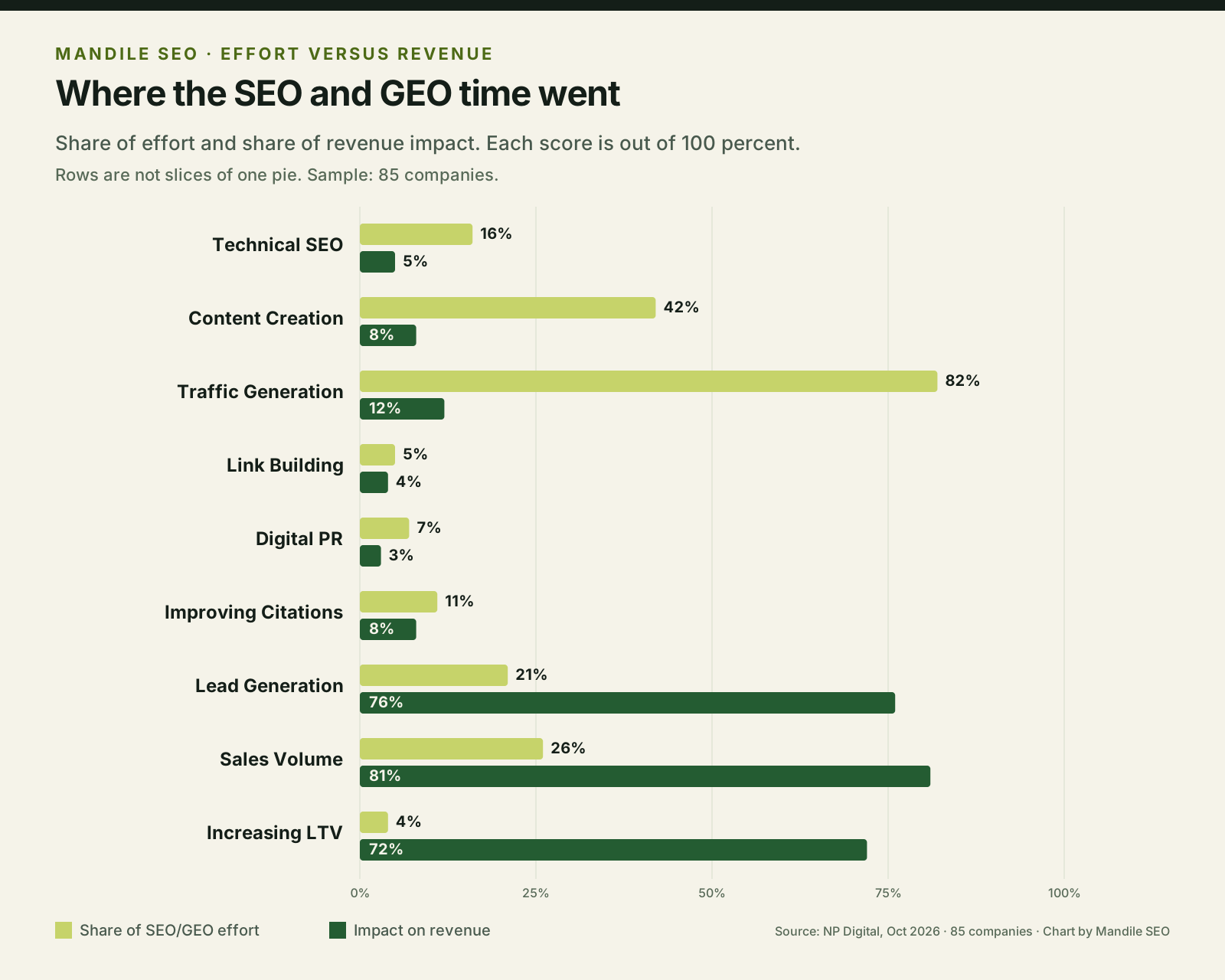
The chart does not say GEO is dead. It says the effort and the revenue do not line up. Traffic generation was 82 percent of effort and 12 percent of revenue impact. Lead generation was 21 and 76. Sales volume was 26 and 81. Lifetime value was 4 percent of effort and 72 percent of impact.
GEO, or generative engine optimization, is the work of making your real services easy for Google AI Overviews, ChatGPT, Gemini, and Perplexity to read. It is not a second SEO product with a secret switch. If the page never says what you do, where you work, and how to call, an AI answer has nothing solid to cite. For the local version of that foundation, start with the Glendale marketing guide and the Glendale and Phoenix metro service areas.
Where does SEO and GEO effort go, and what did those companies tie to revenue?
NP Digital scored each focus area out of 100 percent, not as slices of one pie. Traffic generation was 82 percent of effort and 12 percent of revenue impact. Content creation was 42 and 8. Lead generation was 21 and 76, sales volume 26 and 81, and increasing lifetime value 4 percent of effort and 72 percent of impact.
| Focus area | Share of SEO/GEO effort | Impact on revenue |
|---|---|---|
| Technical SEO | 16% | 5% |
| Content Creation | 42% | 8% |
| Traffic Generation | 82% | 12% |
| Link Building | 5% | 4% |
| Digital PR | 7% | 3% |
| Improving Citations | 11% | 8% |
| Lead Generation | 21% | 76% |
| Sales Volume | 26% | 81% |
| Increasing LTV | 4% | 72% |
Read across the rows, not down a single column. Traffic generation is the tall effort bar and a short revenue bar. Lead generation, sales volume, and increasing LTV flip that shape. Technical SEO (16 percent effort, 5 percent impact), link building (5 and 4), digital PR (7 and 3), and improving citations (11 and 8) are not zeros. They are also not where this sample says the revenue impact sat. A fair limit: NP Digital did not publish this as a study of Glendale plumbers, HVAC companies, or electricians. Use it to check your own scoreboard. Do not treat 76 percent as a result we can hand you.
What should a Glendale or West Valley service business measure instead of traffic?
Count calls that reach you, leads you can name, jobs you book, and customers who hire you again. A website session does not pay a Glendale plumber, electrician, or HVAC company. Traffic can be a clue. It is not the result. The result is paid work and a customer who comes back.
A practical month near Westgate, Historic Downtown Glendale, or the Loop 101 corridor looks like this:
- Calls that reach a person or your approved receptionist. A click that dies on voicemail is not a lead.
- Leads you can name. Name, service, and where the job is. A form attempt with no real request does not count.
- Jobs booked. An appointment request is not a confirmed job until someone on your side accepts it.
- Customers who hire you again. That is the lifetime-value row: 4 percent of the effort in this chart and 72 percent of the revenue impact.
How to wire that up in analytics is a different article. Use clean conversion tracking for the measurement setup, and keep this page as the decision about which numbers deserve the month. Our Local SEO & AI Search program reports approved changes, visibility you can check, and inquiries or map activity where the data is real. It does not promise rankings, leads, or revenue.
Google's own local ranking guidance still lists relevance, distance and prominence. Distance there is how far the person searching is from the business they might hire. It is not the drive from your shop to our office at 5836 W Thunderbird Rd, Glendale, AZ 85306. That address does not limit a client's Map ranking.
How do Google AI Overviews choose sources?
Google says its systems pick the supporting links. A page must be indexed and eligible to show in Search with a snippet. There are no extra technical requirements, and indexing does not guarantee a mention. Overviews may run several related searches, called query fan-out, and appear only when Google decides they add something.
That is the whole technical bar in Google's AI features documentation and its guide to generative AI features in Search. There is no study percentage in those pages for how often a local business is cited, so this article does not invent one. What you can do is make the supporting page obvious: one service, the areas you actually serve, a phone number, and structured data that matches the words on the screen. Google also says indexing and showing a page are never guaranteed.
Do technical SEO, links, and content still matter?
Yes, in proportion. Technical SEO, links, digital PR, citations, and content still showed some revenue impact in the NP Digital data, just less than the time many teams give them. Keep the site crawlable and the business facts accurate. Spend more of the month on calls, booked jobs, and customers who return.
For a local company, "citations" means the name, address, and phone match everywhere a customer might look. That is housekeeping, not a traffic campaign. Content means a page that answers the job someone is trying to hire, not a pile of posts written to move a sessions graph. If a proposal is mostly new blogs, new links, and a traffic dashboard, ask where the calls and booked jobs will be counted.
What happens to local SEO when the call goes unanswered?
A search that ends in voicemail rarely becomes a booked job. Answering while you are on a job, and following up when someone hangs up, is part of the return on being found. In the same 85-company data, increasing lifetime value was 4 percent of effort and 72 percent of revenue impact. Count the people who hire you again.
Two tools cover the gap, and they are not the same thing. An AI receptionist answers the live call, asks what the person needs, and routes it under rules you approve. Missed-call text-back sends a text after a call goes unanswered, and it needs the caller's consent. The AI receptionist setup guide and the missed-call follow-up guide walk through those differences. For a Glendale after-hours comparison, read the answering-service alternative. None of this guarantees answer rates, bookings, or revenue.
People Also Ask: is SEO dead for a local business?
Is SEO dead?
No. In NP Digital's October 2026 data from 85 companies, lead generation, sales volume, and repeat customers had the highest revenue-impact scores. Teams call SEO dead when the calendar is full of traffic work that those same companies scored much lower on revenue impact.
Is GEO dead?
Not according to this chart. GEO effort and revenue impact were measured separately, each out of 100 percent. Traffic work dominated the effort. Leads, sales, and lifetime value dominated the revenue impact. The channel can still matter when the work points at customers, not sessions.
Why is my SEO traffic not turning into customers?
A session is not a customer. In the 85-company data, traffic generation was 82 percent of SEO and GEO effort and 12 percent of revenue impact. If the phone number is hard to tap, or the call goes to voicemail, the visit never becomes a booked job. Count the calls and the jobs.
What should a local business track instead of sessions?
Track calls answered, leads you can name, jobs booked, and customers who hire you again. Those are the numbers a service business can reconcile with the calendar and the invoices. Website sessions are optional context. For the tracking setup, use a separate measurement guide rather than a traffic goal.
Does distance from an SEO company's office affect Google Maps?
No. Google's distance factor is how far the searcher is from the business, not how far the business is from an SEO company's office. Our office is at 5836 W Thunderbird Rd in Glendale. That address does not limit a client's Map ranking in Peoria, Surprise, or anywhere else we work.
How do Google AI Overviews choose sources?
Google says a page must be indexed and eligible to appear in Search with a snippet. There is no extra technical requirement and no special file that forces a citation. AI Overviews show links Google's systems choose, and only when Google decides an overview adds something. Inclusion is not guaranteed.
Want a look at calls, not a traffic chart?
The free Local SEO Check is a dated snapshot of your Google Business Profile, a few Maps searches, and one AI answer. Jeremy replies with what he found and what he would fix first. It is not a full audit and it is not a ranking promise. Mandile SEO, 5836 W Thunderbird Rd, Glendale, AZ 85306.
Sources
- NP Digital, Marketing 2030 Insights chart, "How Much Time Are Marketers Wasting On SEO/GEO?", October 2026. Data from 85 companies. Share of SEO/GEO effort and revenue impact, each scored out of 100 percent. No separate public report URL was available when this page was published on November 8, 2026.
- Neil Patel on LinkedIn, co-founder at Neil Patel Digital, shared the chart in a November 2026 post. The post is the public attribution. This page does not reproduce NP Digital's graphic.
- Google Search Central, "AI features and your website"
- Google Search Central, guide to generative AI features on Google Search
- Google Business Profile Help, local ranking (relevance, distance and prominence)