
How do I know if my business needs an AI agent?
Look for a repeated job that matters, clear rules for a correct outcome, enough volume to justify setup and a safe way for staff to catch mistakes. If every step is predictable, start with a simple automation. If requests arrive in unpredictable conversational language, a narrowly scoped AI agent may help.
First, tell an AI agent apart from an automation
A simple automation follows predetermined steps: when a customer submits a form, send an approved reply and create a CRM task. It may be the cheaper, more reliable first choice for a well-defined process.
An AI agent can interpret more variable inputs and choose among approved actions. For example, an after-hours caller may describe several service needs at once. The agent still needs boundaries, verified business information and a safe handoff. It should never invent a price, arrival time or confirmed booking.
The right question is not “How many agents can I build?” It is “Which job is the business currently failing to complete, and what level of automation is actually necessary?”
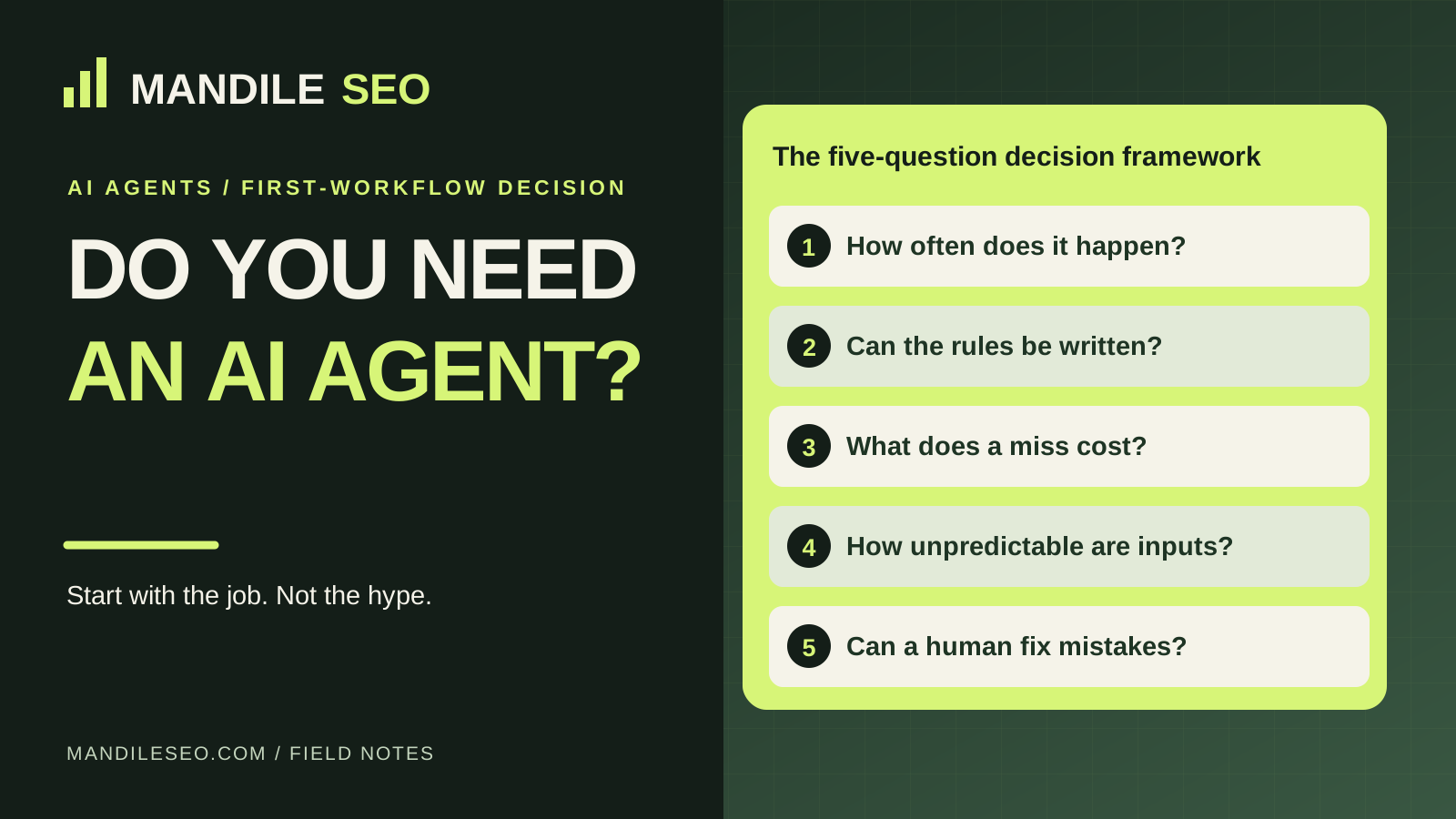
The five-question first-workflow scorecard
Evaluate each candidate job using the same questions. These are a decision worksheet, not a validated predictive scoring model. A high-volume task with low reversibility may be more dangerous to automate than a less frequent task with a reliable human review path.
- Volume: How often does the task happen per day or week? Use actual call, message or operations logs where available.
- Repetitiveness: Does every instance follow known steps, or does the system have to interpret many different requests?
- Cost of a miss: What happens today when the work is missed? Separate measured lost opportunities from guesses.
- Rules: Can you write a one-page definition of what the system may say or do, and what is prohibited?
- Reversibility: Can a person identify and fix mistakes quickly? Escalate or keep a human in control when the consequence is serious.
Six first workflows to consider for a small business
| Candidate workflow | Good fit when | Boundary to test |
|---|---|---|
| After-hours call intake | Calls arrive while technicians or the front desk are busy | Urgent safety requests must follow approved escalation procedures |
| Appointment requests | Calendar rules and service types can be defined | Never call a request a confirmed booking without real verification |
| Lead follow-up | A timely first response follows an approved script | No unapproved prices, discounts or arrival promises |
| Review requests | A job has a clear completion signal | Ask customers neutrally, without incentives or filtering for positive feedback |
| Routine FAQs | Approved source content answers common questions | Owner keeps services, policies and hours current |
| CRM record preparation | Teams repeat the same data-entry fields | Consent, retention, access and error review must be addressed |
Check integration readiness before you commit
Calendar: Can the selected system inspect real availability, write a booking and handle conflicts? If not, describe it as a booking request.
Phone: Confirm what happens if the service disconnects, a transfer fails or a customer asks for a human. Do not promise a 24/7 employee.
CRM and records: Where do notes and transcripts go, who can see them, and how do you correct or delete records where applicable?
Source of truth: Assign one person to maintain approved service descriptions, business hours, price policies and escalation contacts. No source of truth means no safe autonomous answers.
Write the implementation brief before you buy
- Define the job in one sentence, such as “Collect after-hours appointment requests for human confirmation.”
- List approved information and allowed actions: service areas, hours, details to collect, and request routing.
- List prohibited actions: medical or technical diagnosis, exact custom repair quotes, unauthorized promises, payments or sensitive disclosures.
- Define human handoff: escalation triggers, contacts, availability and a fallback if the transfer fails.
- Set data rules: minimum necessary details, access, retention, consent and ownership.
- Specify acceptance tests and success measures: correct routing, errors, follow-up completion and actual confirmed bookings when available.
When you should not build an AI agent yet
Do not build simply because a competitor has an agent. A task that happens twice a month may cost less to handle manually. If no one can explain a correct outcome, stabilize the underlying process first.
Avoid fully automated responses to safety-critical problems, sensitive personal information or irreversible decisions without appropriate specialist review. A workflow can often begin with draft preparation or notification instead of independent action.
Common questions about first AI workflows
What should I automate first? Start with a repetitive job whose cost of delay is real and whose instructions and mistakes can be reviewed.
Can an agent book appointments? Only if the integration and calendar rules are configured, authorized and tested. Otherwise it must request an appointment, not confirm one.
What does the first pilot cost? Costs depend on scope, usage and integrations. See our separate AI agent pricing guide for public vendor rate examples and exclusions.
Want to turn your first workflow into a reviewable plan?
Describe the task, how often it happens, your existing tools and the handoff a person must keep. Mandile SEO can help scope a narrow pilot without claiming the system is live before it has been tested.