
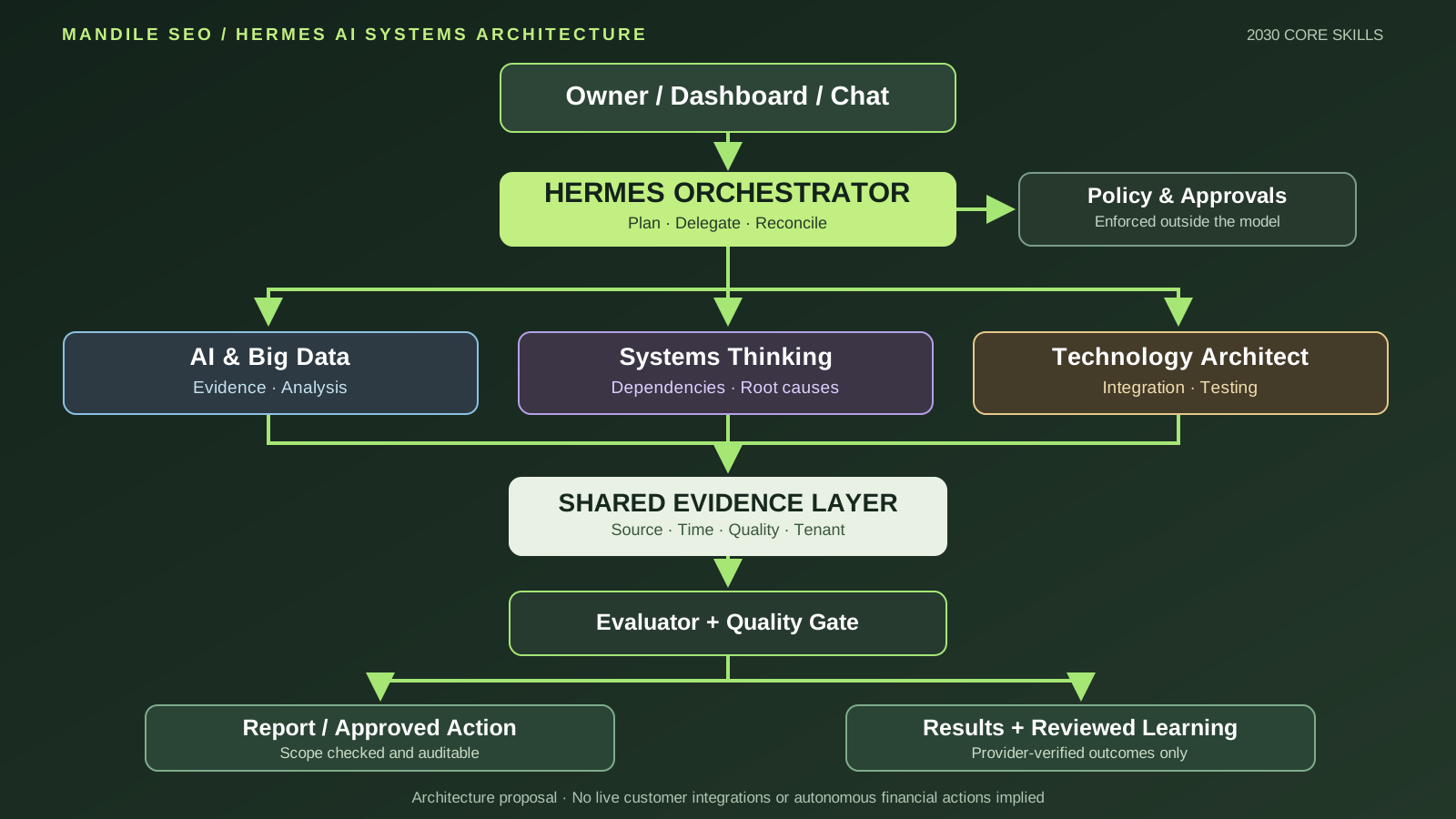
Hermes coordinates. Evidence and software-enforced permissions decide what is allowed.
It should not ask three AI models for answers and choose the majority. Instead, collect verifiable information, map the system, compare possible fixes, approve any external change, test it, and measure whether the source systems confirm an improvement.
Three core skills, four agent roles
AI & Big Data brings traceable observations, normalized records, quality checks and trend analysis. Systems Thinking asks how bottlenecks, dependencies, feedback loops and delays affect the entire business. Technological Literacy determines whether the best intervention is an existing platform, direct API, MCP connector, ordinary automation or a custom service.
| Agent | Primary question | Deliverable |
|---|---|---|
| Hermes Orchestrator | What decision is needed, and who can authorize it? | Scoped plan, consensus checking, final decision record |
| AI & Big Data | What do the actual sources show? | Time-bounded evidence, anomalies, data gaps |
| Systems Thinking | Where is the root bottleneck, and what happens downstream? | Dependency map, competing hypotheses, leverage points |
| Technology Architect | Which tools can safely solve the measured problem? | Integration design, test, cost, failure and rollback plan |
The seven-stage Hermes AI agent workflow
- 1. Define. Specify owner, allowed data, task scope, deadline, baseline and measurable business outcome.
- 2. Observe. Collect only authorized data; attach source ID, timestamp, period, tenant and quality flags.
- 3. Understand. Map dependencies and feedback loops. Test competing causes instead of trusting the first story.
- 4. Design. Compare a simple automation, an AI agent and a human process; score impact, effort, risk and reversibility.
- 5. Gate. Independent code checks permissions, evidence quality, scope and approval before any write.
- 6. Execute. Prefer read-only recommendations. A separate private worker performs only approved, idempotent actions.
- 7. Verify. Check provider receipts, compare against baseline, log confounders and retain only reviewed lessons.
Any model output remains a proposal until validated. An action is confirmed only when the actual provider acknowledges it. A failed tool call, partial response or timeout must not be presented as a completed booking, payment, email or deployment.
12 industries and AI agent applications
These are practical ideas and designs that could be developed into pilots. They are not claims that Mandile SEO has deployed all these systems for paying customers.
| Industry | Application | Workflow | Verified outcome |
|---|---|---|---|
| Local SEO & digital agencies | Find why visibility is not becoming qualified leads Possible inputs: Search Console, consented analytics, accepted CRM lead records | Analyze each funnel stage, check tracking, recommend highest-leverage test | Provider-accepted inquiries and qualified leads |
| Plumbing & HVAC | Improve after-hours inquiry handoff Possible inputs: Call events, service areas, approved technician roster | Triage → authorized alert → wait for human acceptance | Acknowledged requests and real booked jobs |
| Computer repair & managed IT | Reduce repeat repair incidents Possible inputs: Ticket categories, repair outcomes, part and warranty codes | Find repeat patterns → map root causes → propose QA changes | Verified repeat ticket rate |
| Real estate | Respond accurately to buyer and seller inquiries Possible inputs: Approved CRM, listing feed, staff calendar | Deduplicate → verify listing status → propose response → staff confirm | Booking-provider-confirmed consultations |
| Healthcare administration | Reduce non-clinical scheduling backlog Possible inputs: Approved, minimum-necessary capacity statistics | Analyze availability and handoff delays → propose staffing improvements | Verified schedule utilization |
| Retail & ecommerce | Explain conversion and refund friction Possible inputs: Consent-aware sessions, stock data, provider receipts | Segment drop-offs → check policy and inventory → test copy | Paid orders net of cancellations |
| Logistics & field services | Identify delivery delay propagation Possible inputs: Route events, dispatch timelines, staffing constraints | Map upstream dependencies and model alternatives | On-time confirmed deliveries |
| Manufacturing | Reduce equipment downtime Possible inputs: Machine telemetry and signed-off maintenance history | Flag anomalies → model bottlenecks → propose work order | Verified downtime after review |
| Hotels & hospitality | Resolve guest requests reliably Possible inputs: Permissioned PMS/helpdesk states and service rosters | Identify stalled handoffs → notify owner → confirm closure | Request closure with audit evidence |
| Financial & insurance operations | Reduce repetitive intake rework Possible inputs: Approved non-sensitive workflow states and missing document counts | Map rework queues → propose process checks | Verified time to completed intake |
| Education & training | Improve completion without surveillance Possible inputs: Consented, appropriately aggregated learning events | Compare cohorts → propose curriculum intervention | Observed completion and comprehension |
| Nonprofits | Find donation and volunteer handoff gaps Possible inputs: Permissioned campaign metrics and processor receipts | Test drop-off causes → propose fixes → verify result | Confirmed donations and filled shifts |
Four example use cases, end to end
SEO growth intelligence
Business question: Why are impressions increasing but qualified leads are flat?
Authorized evidence: Search Console + analytics + actual lead receipt and CRM qualification
Systems analysis: Examine whether click intent, broken forms or late replies explain the gap before creating more content.
Proposed action: Propose a staged form test or targeted page change with owner review.
Measure: Qualified, accepted leads—not raw impressions or clicked buttons.
Contractor call recovery
Business question: Are after-hours plumbing requests reaching the on-call team?
Authorized evidence: Permitted call timestamps, service areas, human acknowledgment and bookings
Systems analysis: Separate caller intake, staff notified, human accepted and job booked.
Proposed action: Recommend fallback handoff; never invent emergency dispatch.
Measure: Human-acknowledged requests and booking-provider confirmation.
Computer repair operations
Business question: Why do certain laptop repairs return to the shop?
Authorized evidence: Repair categories, technician notes under access control, parts batches and return reasons
Systems analysis: Distinguish one-off returns from a repeat process, supplier or diagnostic issue.
Proposed action: Propose approved bench checklist or parts inspection.
Measure: Repeat service incidents and real repair close times.
Real estate inquiries
Business question: Which buyer leads are going stale?
Authorized evidence: Authorized contact preference, CRM state, listing feed and staff availability
Systems analysis: Trace delay from inquiry to verified agent follow-up, not hypothetical close rate.
Proposed action: Draft broker-reviewed answers and appointment requests.
Measure: Actually confirmed broker conversations.
Why evidence is different from memory
Hermes can maintain useful procedural memory, but memory is not a database of verified client events. Maintain separate, tenant-scoped source references, observations, hypotheses, proposals, provider receipts and outcome comparisons. Numerical results need a known metric definition and observation window. A form submission attempt does not prove a CRM accepted it; a booked request does not prove an invoice was paid.
Hypothetical SEO example: 1,200 impressions, 45 clicks, 4 form attempts, 2 provider-accepted inquiries and 1 qualified lead. A careless agent might call that 4 leads. A defensible one investigates the failed handoffs before recommending additional content. These are fictional teaching figures, not Mandile SEO performance data.
Permissions, testing, and human approval
A skill description cannot enforce security. Real restrictions belong in authorization middleware and the connected services. Start with read-only connectors; identify each tenant and actor; minimize retained data; require scoped and expiring approval for writes; apply idempotency keys, rate limits, audit logs and rollback plans; reconcile ambiguous provider responses before retrying.
Financial actions, credential resets, deletions, customer contact campaigns and sensitive operational decisions need separate human-controlled processes. Healthcare, finance, legal intake and housing workflows carry additional domain-specific restrictions.
How to build a first pilot
- Choose one measurable task. For example, find the source of unqualified local SEO leads or identify repair-ticket bottlenecks.
- Install Hermes in a private environment. Use its published documentation and scoped operator credentials—not the public marketing website.
- Add four portable skills. Orchestrator, data analyst, systems thinker and technology architect, with independently enforced access rules.
- Connect one read-only source. Record missing permissions rather than guessing the data.
- Test with synthetic scenarios. Include stale sources, rejected access, duplicates and confusing handoffs.
- Run a human-reviewed pilot. Evaluate evidence quality and the proposed next action before adding any write permissions.
See the official Hermes Agent documentation for runtime capabilities and its skills system. The industry architecture and action contracts described here are original proposals, not built-in Hermes services.
Start with the business bottleneck, not the bot.
Mandile SEO brings established technical SEO and WordPress experience to practical AI workflow discovery. Agent deployments and integrations are evaluated as custom-scoped pilots; no production voice-agent track record or guaranteed revenue result is implied.