
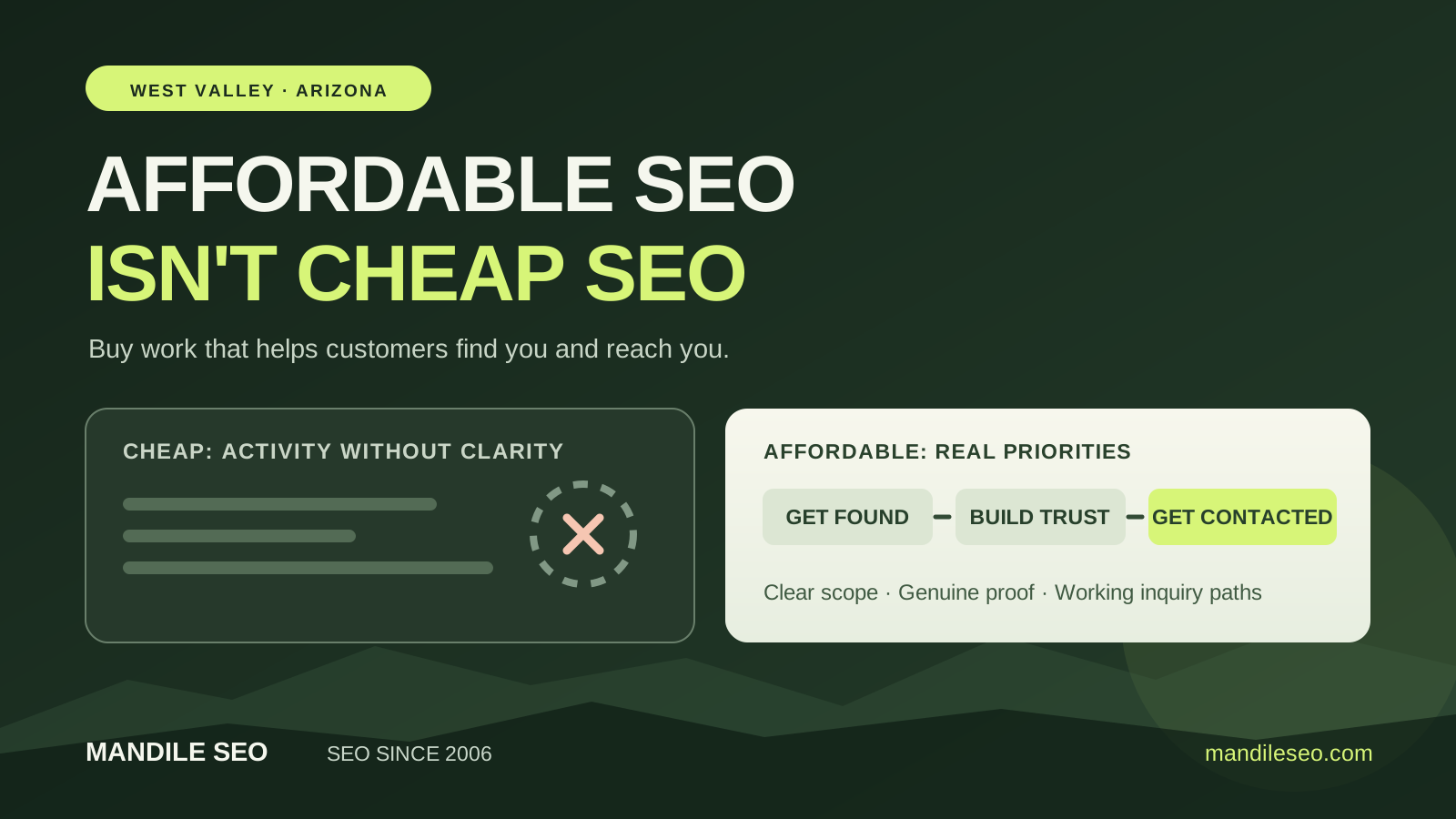
What's the difference between affordable SEO and cheap SEO?
Affordable SEO is focused, transparent and useful. You know which problem is being solved, what work is included, and how progress will be checked. Cheap SEO is a low price attached to vague deliverables, shortcuts or activity that never connects to customers. A higher price is not automatically better, either: judge the scope and evidence, not the sales pitch.
If you run a small business in Glendale, Peoria, Surprise, Goodyear or elsewhere in the West Valley, you've probably heard some big numbers for SEO. But do you really need a $3,000-a-month retainer to improve how nearby customers find your business? Not necessarily. Your needs depend on your competition, website, locations and the work you can already handle.
It really is a bit of the Wild West in AI search right now. New terminology is everywhere. Some providers sell "AI SEO" as though adding a chatbot, a few keywords or a special schema file will automatically put a business in ChatGPT. That's not how responsible search marketing works.
The price tag matters less than what you're buying
Ahrefs surveyed 439 SEO providers and reported an estimated average monthly agency retainer of $3,209 and an average freelancer retainer around $1,348. Those are provider-reported benchmarks from its survey, not a quote for a West Valley business or evidence that every small shop needs a retainer.
A business with multiple locations, competitive markets and a full content program may need substantial ongoing work. A neighborhood shop with a limited number of services might benefit more from fixing obvious technical problems, improving its business listing, and explaining its services clearly before committing to a large contract.
| Look for | Affordable SEO | Cheap SEO warning sign |
|---|---|---|
| Scope | Named pages, technical fixes and agreed priorities | "We'll optimize everything" with no deliverables |
| Trust | Real reviews, accurate business information and credible mentions | Purchased reviews, fabricated listings or bulk link packages |
| Reporting | What changed, what was observed and what inquiries were actually received | Ranking screenshots with no explanation of customer impact |
| Ownership | Your website, profiles and content remain under your control | The vendor holds your essential accounts hostage |
Where a limited West Valley SEO budget can make a difference
Start with the customer journey rather than a random checklist of SEO tricks. For a local contractor near Arrowhead Ranch, a service business around Westgate, or a Peoria shop serving Sun City, the first question is simple: can a nearby customer understand what you do and reach you?
- Make your Google Business Profile accurate. Verify the business category, relevant services, genuine photos, hours and contact information. An accurate profile helps people evaluate the business; no one can guarantee a map-pack position.
- Earn and respond to authentic reviews. Ask real customers without incentives that violate platform policies. Reply usefully rather than stuffing location keywords into every response.
- Give each meaningful service a clear home. A dedicated water-heater repair page can explain actual services, coverage and next steps better than a generic list. Create a page because it helps a customer—not just to repeat a city name.
- Remove mobile friction. Check loading speed, readable text, tap targets and whether the phone number and quote request actually work. Technical SEO is valuable when it fixes a real obstacle.
- Keep your business identity consistent. The name, address when applicable, phone and website should accurately describe the same real business across public listings.
- Make your business understandable in AI search. Explain your real services, service area and business identity consistently. Clear content and accurate public information can support discovery across Google and AI answer systems; no platform guarantees recommendations.
And don't forget the most important customer-facing part: a working call, quote or appointment-request path. Being visible doesn't help much when someone cannot contact you.
If you want a Glendale-specific pricing and setup breakdown, read our companion guide: Affordable SEO for Small Businesses in Glendale, AZ. This article addresses the bigger decision: how to avoid wasting money while preparing for traditional and AI-assisted discovery.
The Short List Effect: why AI search raises the stakes
Here's what fascinates me about generative engine optimization (GEO): the Short List Effect. With traditional Google search, customers can browse multiple pages of results and map listings. When someone asks ChatGPT, Claude, Gemini or Perplexity who to hire, the answer may surface only a few options—sometimes three or four. That's not a fixed rule across platforms or prompts, but it changes how a customer may start the decision.
Imagine a homeowner asking, "Who repairs water heaters in Peoria and can explain the estimate before coming out?" If an AI answer presents a short list of businesses, a company omitted from that particular answer may never enter that customer's consideration set. And being listed once doesn't mean the same business will appear for every person, prompt or location.
| Traditional local search | AI-assisted recommendations |
|---|---|
| Customers browse search results and map listings, then compare providers themselves. | An assistant may summarize a smaller set of options and explain why each could be relevant. |
| Relevance, accessible pages, business information and customer trust affect discovery. | Those same foundations matter, but the exact sources, citations and names in an answer can vary from prompt to prompt. |
| A ranking or map impression is not an inquiry. | A mention, citation or recommendation is also not an inquiry. |
That is why I think we're moving beyond optimizing only for rankings. We also need to ask whether a search system can identify the business, understand its actual work and find credible evidence that supports describing it to a customer. I've also explained the Short List Effect on our Local SEO and AI Search service page.
Three trust signals worth strengthening before buying "AI SEO"
1. Genuine third-party brand mentions
Look for real, relevant references outside your own website: local organizations, professional directories, community publications, trade associations or customers speaking about work they actually received. Quality and relevance matter more than buying hundreds of generic citations. Neither a mention nor a backlink guarantees an AI recommendation.
2. Credible context around those mentions
A business name by itself is less helpful than a description that accurately connects the business to a service, location and reason to choose it. For example, an independent reference to a Peoria repair company that clearly describes its diagnostic services gives a reader more context than a directory entry saying only "computer store."
3. Accurate, readable business information and structured data
Useful service pages, correct public contact details and appropriate schema markup can make a site easier for search systems to interpret. But structured data is descriptive markup, not a way to train an assistant to recommend you. Google explicitly says valid markup does not guarantee a special search appearance. Its AI features guidance also says normal SEO best practices remain relevant and no special AI-only schema is necessary. The facts in markup should match the actual page.
A small naming problem I found with Mandile SEO
In one limited AI visibility check, my business was named in 8 of 24 sampled answers—but under my Google listing name, Mandile Marketing, not the website brand, Mandile SEO. That's a useful clue that public business-name associations deserve attention.
It's not a controlled study, proof of a platform-wide problem, or evidence that I lost a particular lead. It gives me a practical action: make sure my website and other accurate public references explain that the two names refer to the same business. A naming mismatch does not automatically cause an AI assistant to exclude a company; it is a reason to check for confusing or inconsistent facts. Local businesses should check their own names, locations and service descriptions for similar issues before paying for more content.
Visibility, citations and recommendations are not the finish line
Getting retrieved by a system is one outcome. Being cited as a source is another. Being named as a business worth considering is another still. None automatically becomes a call, quote request, confirmed appointment or paying customer.
Two small conversion details can make a big difference to the person who visits after an AI recommendation:
Match the reason someone chose you
If a search answer points to your business for a particular specialty, your landing page should clearly confirm the real specialty, service area and process. Don't invent a claim just to match a possible AI description. Give customers a straightforward reason to see whether you're the right fit.
Make the next action unmistakable
A customer asking AI to "find a template," "get a quote" or "book a consultation" wants to accomplish a task. Link to the relevant template, show what information a quote requires, and make clear whether an appointment is actually booked or merely requested. Our direct-action AI prompts guide explains how those paths work without promising automated bookings.
Track the steps you can reliably observe: search visibility snapshots, referral visits where reported, received inquiries, qualified opportunities and confirmed work. A phone call or form submission is not automatically attributable to one AI answer; ask the customer how they found you, and keep unknown attribution labeled as unknown.
What Mandile SEO actually offers
I've worked with local SEO and WordPress since 2006 and practical AI since 2022. AI handles repetitive audits, technical checks and first drafts; I review and approve every change before it goes live. The ongoing SEO program has a published price, with exact work and terms agreed in writing.
Ongoing local SEO & AI search: $1,000 one-time setup, then $1,197 per month. Before work starts, we agree on service areas, monthly deliverables, reporting, billing dates, paid third-party tools and cancellation terms. This is not a guarantee of rankings, AI recommendations or leads.
For a WordPress website, Mandile SEO offers a scoped $1,000 one-time speed and technical SEO cleanup. After a completed cleanup, optional $197/month WordPress care can cover a separately agreed maintenance scope. That monthly care plan is not a comprehensive ongoing local SEO or GEO retainer.
Need a simple starting website? The $497 Signature Site is a separate one-page offer with defined limits and a revision. The ongoing local SEO program is a separate $1,000 setup plus $1,197/month service; other custom SEO and AI projects receive their own written scope. None comes with a guarantee of rankings, AI recommendations or inquiries.
Questions to ask before you hire anyone for SEO
Before you pay, ask what will actually change on your site or profile; which tasks are one-time versus ongoing; who owns the accounts; how the work will be documented; and what constitutes a real inquiry. Ask for the scope in writing, especially when "AI search" appears in the proposal. For more questions, see how to choose an SEO company in Glendale.
A good SEO proposal doesn't need to promise page-one rankings or a spot on every AI shortlist. It needs to explain the work, the evidence and the realistic next step.
Spend on the fixes that matter. Skip the SEO theater.
If you run a business in Glendale, Peoria, Sun City, Surprise, Avondale, Goodyear or nearby West Phoenix, tell me about your website and what isn't working. I'll help you identify what may be worth reviewing first—without pretending a low price buys every SEO service.